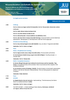
“Circulation of Knowledge and the Aesthetics of the Spectacular”
28–29 January 2026 | Justus Liebig University Giessen
The first conference of the DFG Research Unit marked the programmatic launch of our collaborative
work. At its core was the interdisciplinary analysis of the circulation of knowledge and the
aestheticization of the spectacular in the context of antiziganist external and self-ascriptions in
Europe between 1850 and 1950. The discussions focused on transfers, synchronies, and
asynchronies between different European regions (including Spain, Germany, and Romania), as well
as on the tension between antiziganism and agency.
In her opening address, the spokesperson of the Research Unit, Prof. Dr. Iulia-Karin Patruț,
emphasized the innovative potential of interdisciplinary collaboration. She highlighted the necessity
of systematically analyzing simultaneities and ambivalences and of situating antiziganism within a
triangulation with antisemitism and colonial racism, also building on insights from the Winter
School “Critical Whiteness and Antigypsyism” held at Europa-Universität Flensburg in December
2025.
The keynote lecture by Prof. Dr. Klaus-Michael Bogdal (“Nous, les Gitans? Imagined Identities”),
including a film screening, established a conceptual framework for analyzing aesthetic attributions
of identity. The subsequent panel on research perspectives combined approaches from political
science, cultural studies, and transdisciplinary research, featuring contributions on the
“Securitization of the Roma” (Dr. Laura Tittel) and “Travelling Concepts” (Dr. Doris Bachmann-
Medick). The discussion addressed the transferability of concepts and the entanglement of
knowledge regimes in a lively and critical manner.
A second panel explored the European comparative dimension. Dr. Marian Zăloagă examined Roma
music ensembles at world fairs and their reception both domestically and internationally, while Dr.
Ion Duminica analyzed discriminatory and criminalizing press representations of Roma in interwar
Romania. The discussion highlighted recurring motifs of antigypsyist representation across Europe,
practices of media framing, and their function in legitimizing exclusion, oppression, and racial
profiling. At the end of the first day, Dr. Magda Matache presented her book The Performance of
Anti-Roma: (Un)uttered Sentences (2025), in which she examines anti-Roma racism as a historically
rooted and ongoing social practice.
On the following day, the European dimension was further deepened through lectures by Prof. Dr.
Sarga Moussa (“Bohémiens et Bohémiennes dans les Voyages en Orient au XIXe siècle”) and Prof.
Dr. Kirsten von Hagen on scenes of knowledge and the spectacular in Théophile Gautier’s travel
account Voyage en Espagne.
In the final panel, early-career researchers of the DFG Research Unit presented reflections from the
subprojects. Contributions drawing on literary, filmic, journalistic, and historiographical sources
demonstrated the methodological breadth within the Research Unit. The panel opened with a
significant presentation by Dr. Dezso Mate on “Gypsyloreism and Romani Agency,” addressing
conflicts within different reparative stages and processes, and engaging closely with the conceptual
framework of the Research Unit.
The concluding session and subsequent coordination meeting focused on evaluation and the
strategic development of the collaborative project. The development of the virtual research
environment as a key instrument for interdisciplinary collaboration was presented by Dr.
Mohammad Fazleh Elahi and discussed with the subprojects.