

Culture - Language - Media (KSM) – Master of Arts (M.A.)

Become an expert in intercultural interaction in different cultural fields and disciplines.

Contents

You learn more about cultures when you set your own priorities!

In the KSM program, you’ll become an expert in several cultural fields and their interactions – for example, the German, English, Danish, French, or Spanish cultural fields. In other words, you’ll become a language and cultural mediator.

With your personal mix of six disciplines, you will be well equipped at the end of your studies to find the right words and ideas in a globally connected world. With us, you can put together your own master’s degree from the following specializations:

  • Cultural studies
  • Art/Visual culture
  • Media studies
  • Literature studies
  • Linguistics
  • Intercultural business administration

Internships are included in the degree program and do not extend the duration of your studies. Thanks to our network in the fields of business and culture, we can support you in your search for an internship. The combination of projects and an optional semester abroad qualifies you for a successful future in Germany or abroad.

The degree program at a glance

Degree

Master of Arts (M.A.)

Duration

4 semesters (= 2 years)

Study start

Fall semester (= September)

Languages

German, English

Application period

Application period for EU citizens: May 15 to August 15

Application period for non-EU citizens: December 3 to August 15

Tuition fees

None, but a semester fee is payable each semester

Type of course

Full time

Semester abroad

Optional

Internship

Mandatory

Here you’ll find everything you need to know about applying, admission, and deadlines

To the info

Want a first impression?

Course content: What this degree program is all about

  • Intercultural interaction and cooperation
  • Six sub-disciplines you can focus on:
    • Linguistics
    • Literary studies
    • Cultural studies
    • Art/visual culture
    • Media studies
    • Intercultural business administration
  • Modernity in Northern Europe and the transatlantic region
  • Intersections between Scandinavian, German, English, French and Spanish-speaking countries
  • Research methods
  • Basic knowledge of media design

Checklist: Is this degree program right for you?

  • You find it interesting to examine social phenomena from different perspectives.
  • You are looking for an international and welcoming degree program.
  • You are interested in the intersections between culture and economics.
  • You want to do something with media.
  • You are looking for an alternative to teaching.
  • You love languages and have no problem with bilingual teaching.
  • You want to set your own priorities and focus on what interests you the most.
  • Personal support during your studies is important to you.
     

Course structure: Your path through the KSM degree program

1. Semester2. Semester3. Semester4. Semester
Module 1: InterculturalityModule 2: Contact and conflict – interdisciplinaryModule 4: Identity and alterity – interdisciplinaryModule 7: Master’s thesis
Module 3: Contact and conflict – focusedModule 5: Identity and alterity – focused
Module 6: Internship and project module

This is what your studies will look like – semester by semester

Your introduction to the KSM master’s program: You will take the Interculturality module with six introductory courses in the sub-disciplines of the program – linguistics, literary studies, cultural studies, art/visual culture, media studies, and intercultural business administration.

In the second semester, you can tailor your studies to your preferences. Choose your focus areas: double up on disciplines, or drop some. You can of course also continue with the multi-disciplinary approach if you wish. In this semester, you will examine cultural contact and conflicts from different perspectives. You will have the opportunity to apply your creative, organizational, and practical skills in a project.

You will continue to study your chosen specializations in one of our six disciplines or set new specializations. You can of course also continue with the multi-disciplinary approach and study all six disciplines if you wish. In this semester, you will focus on the aspects of identity (the self) and otherness (the foreign). You will also outline your own research project, which you can later develop into your master’s thesis. An internship in Germany or abroad will strengthen your job prospects. And if you want to study abroad for a semester, this is the best time to do so.

In the fourth and final semester of the KSM program, the focus is on your master’s thesis. It can either be research-oriented or carried out in cooperation with a company or organization. You can also complete your internship in the fourth semester.

Semester abroad and internship abroad: Discover the world!

In the third semester of your KSM studies, you have the opportunity to spend a semester abroad. We highly recommend this: you will get to know a different culture, improve your language skills, make friends and acquaintances all over the world, and create memories that you will never forget.

  • KSM graduate Anja raves: “For me, my semester abroad in England was a total revelation. For example, it was a huge boost for my language skills. I had always been good at English, but this was incomparable. Living there and completely immersing myself was a huge experience for me. I surpassed my own expectations. You get to know yourself in a completely different way and realize how you react in an unfamiliar environment and that you will sometimes feel bad about it, but also that you can find ways to get out of it yourself.”
  • By the way, EUF’s International Center will help you with every step of planning your semester abroad. And it’s funded by the Erasmus program. There are almost 90 EUF partner universities worldwide to choose from.

While a semester abroad is voluntary, an internship abroad is mandatory for the KSM program. Go out into the wide world or stay local and commute to Denmark every morning – both count as an internship abroad. We are happy to advise you on this part of your studies.

Want to know all the details?

All info about the program at a glance

Download Flyer (PDF, 668 KB)

Help and advice: Where to find support

  • International Center (IC)
    The International Center looks after international students and helps with questions about stays abroad.
  • Patrick Will
    Patrick, who is part of the IC team, is responsible for FIT@EUF, a project that supports the integration of international talent into EUF and the job market in Germany. He would be happy to answer your questions and help you find the degree program that’s right for you.

Student feedback: What they say about the program

Admission requirements: What you need to study KSM

At a glance

  • The program is open to all applicants – there is no minimum grade requirement (NC).
  • During your bachelor’s degree program, you should have earned at least 60 credit points in literature, linguistics, cultural studies, media studies, or art/visual culture, for example, as part of a degree in English, German, Scandinavian, French, linguistics, or comparative literature.
  • You must speak German and English and be able to provide proof of this.

For those who want to know exactly what they need to do:

Check admission requirements

Career prospects: What happens after graduation?

Career prospects

The KSM degree program opens up many different careers for you – both in Germany and abroad. Depending on your areas of focus and the contacts you make during your studies, many doors will be open to you. 

We prepare you for professional life with internships and projects – take a look at the exciting internship reports from our students who have gained experience at various places, including NDR’s Strg-F, Delta Radio, bookstores, and the Goethe Institute in Wellington, New Zealand. 

One highlight of our program is its own magazine, Literasea, which you are welcome to contribute to if you are interested.

Typical places of work for KSM graduates:

  • Cultural institutions
  • EU and government institutions
  • International aid organizations
  • Schools, universities, and other educational institutions
  • Publishing houses and other media outlets
  • Advertising agencies
  • Trade unions

Typical career paths:

  • You could organize courses and conferences as a coordinator at a university language center.
  • You could write articles for a magazine or newspaper as an online editor, or in the field of public relations.
  • You could teach or lecture at an educational institution.
  • You could head the language department of a Goethe Institute abroad.
  • You could set up a marketing and corporate communications department in a company.
  • You could manage the children’s and youth marketing for a well-known sports club.
  • You could organize appointments, accompany members of parliament, and take on press duties as a research assistant or advisor to a member of the Bundestag.
  • Read the success stories of our alumni here:

Doctorate

With a master’s degree in KSM, you also have the opportunity to pursue a doctorate. This will earn you the academic degree of doctor in a specific field of study.

Doctoral studies at EUF

Frequently Asked Questions (FAQ)

KSM stands for Kultur – Sprache – Medien, the German equivalent for Culture – Language – Media.

With the M.A. in KSM, you learn about languages and cultures from different perspectives. This will not only open up the international job market to you, but also give you a new perspective on the world. You will study exciting topics bilingually and can focus on areas that interest you. This allows you to tailor the master’s program to your needs. You will be supported by expert lecturers who can answer your questions and help you with any problems you may have. Projects and 1–2 internships will prepare you for the professional world. The optional semester abroad is an added bonus – an unforgettable experience for many of our graduates.

No, the semester abroad is optional. However, if you decide to go, you will receive all the support you need. The EUF’s International Center will help you with planning and implementation. Your semester will be financed through the Erasmus program.

The program is open to all applicants. You just need to have a bachelor’s degree in a relevant subject, such as cultural studies, and be able to speak German and English. You can find the exact application requirements on the application page of the program.

You must demonstrate adequate German and English language skills. The exact language requirements can be found on the application page of the program.

EUF has a rating of 4 out of 5 stars on Studycheck. 93 percent of students would recommend EUF to others.

The KSM program has a rating of 4.9 out of 5 stars on Studycheck – even better than EUF's overall rating. Students praise the interesting topics and the knowledge they gain from the program. They point out that the program offers many career opportunities – those who don’t yet have an idea of where they want to go should start thinking about it early on and choose the right specializations.

The KSM degree program opens up a wide range of career opportunities. You can work in cultural institutions, governmental and non-governmental organizations, media companies and publishing houses, schools and universities. You set your own priorities during your studies and thus also set the course for your future career. Our website features numerous interviews with graduates – perhaps they will inspire you!

Your contacts for questions and problems are the KSM academic advisors, as well as the International Center, with Patrick Will being responsible for FIT@EUF, a project that supports the integration of international talent into EUF and the job market in Germany. He will be happy to answer any questions you may have about your studies.

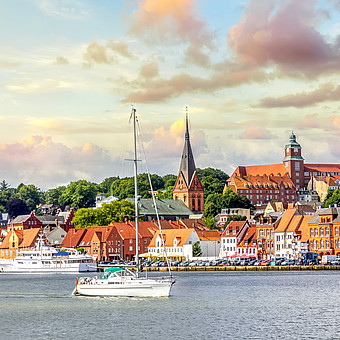
EUF is a small, friendly university in northern Germany with a green campus and many international students. There are free language courses, a sports center, a swimming pool, and various student organizations (political, environmental, intercultural, religious, etc.). In the evenings, there are often themed events, such as movie and game nights, theater performances, or barbecues. You can reach several beaches by bus, as Flensburg is located on the Flensburg Firth. The Baltic Sea, the North Sea, and Denmark are not far away. Hamburg is only two hours away by train.

Overview of all degree programs

Browse degree programs

KSM on social media

Sign up for the KSM newsletter by sending us an email

Send email

Accreditation