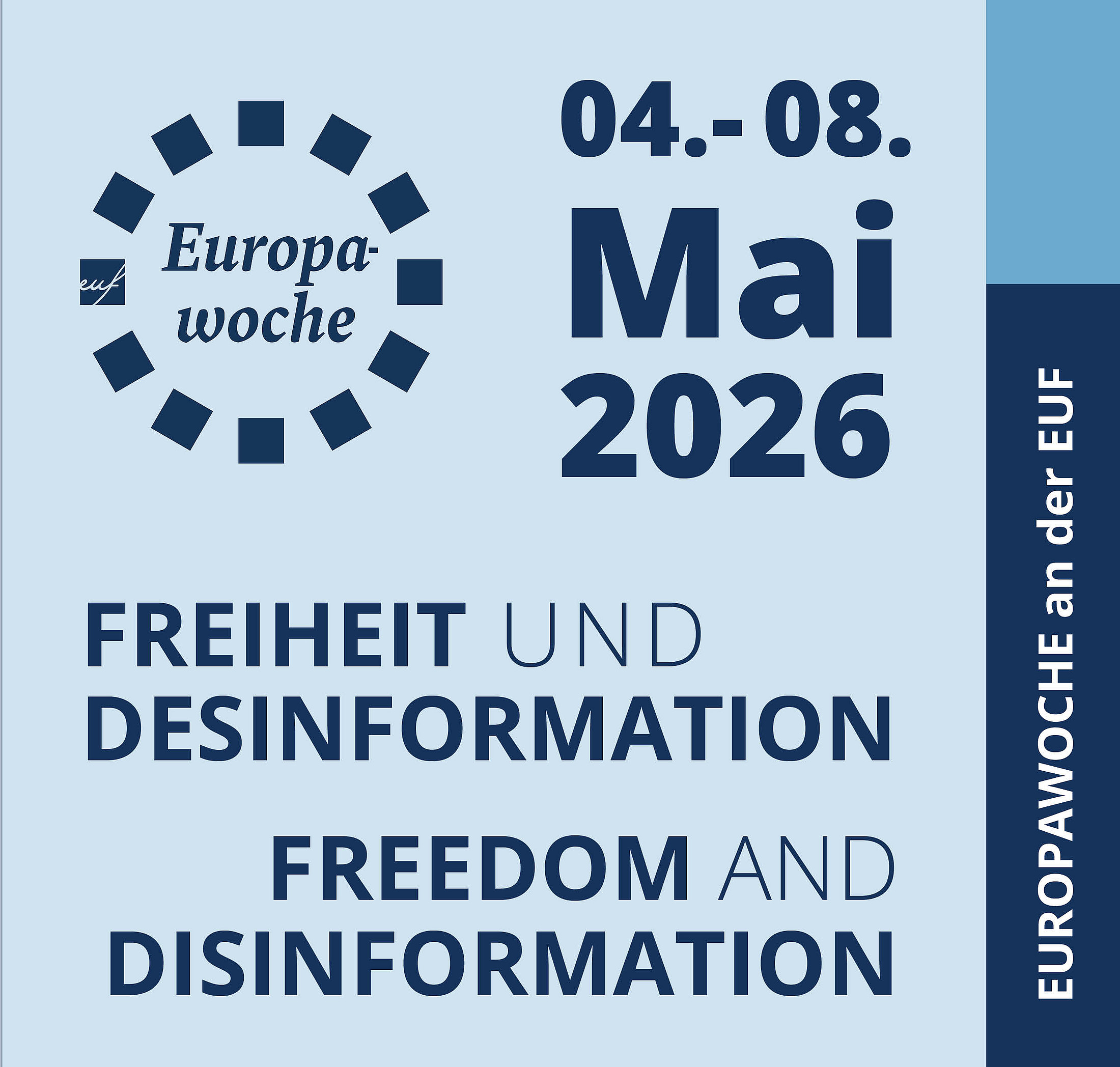
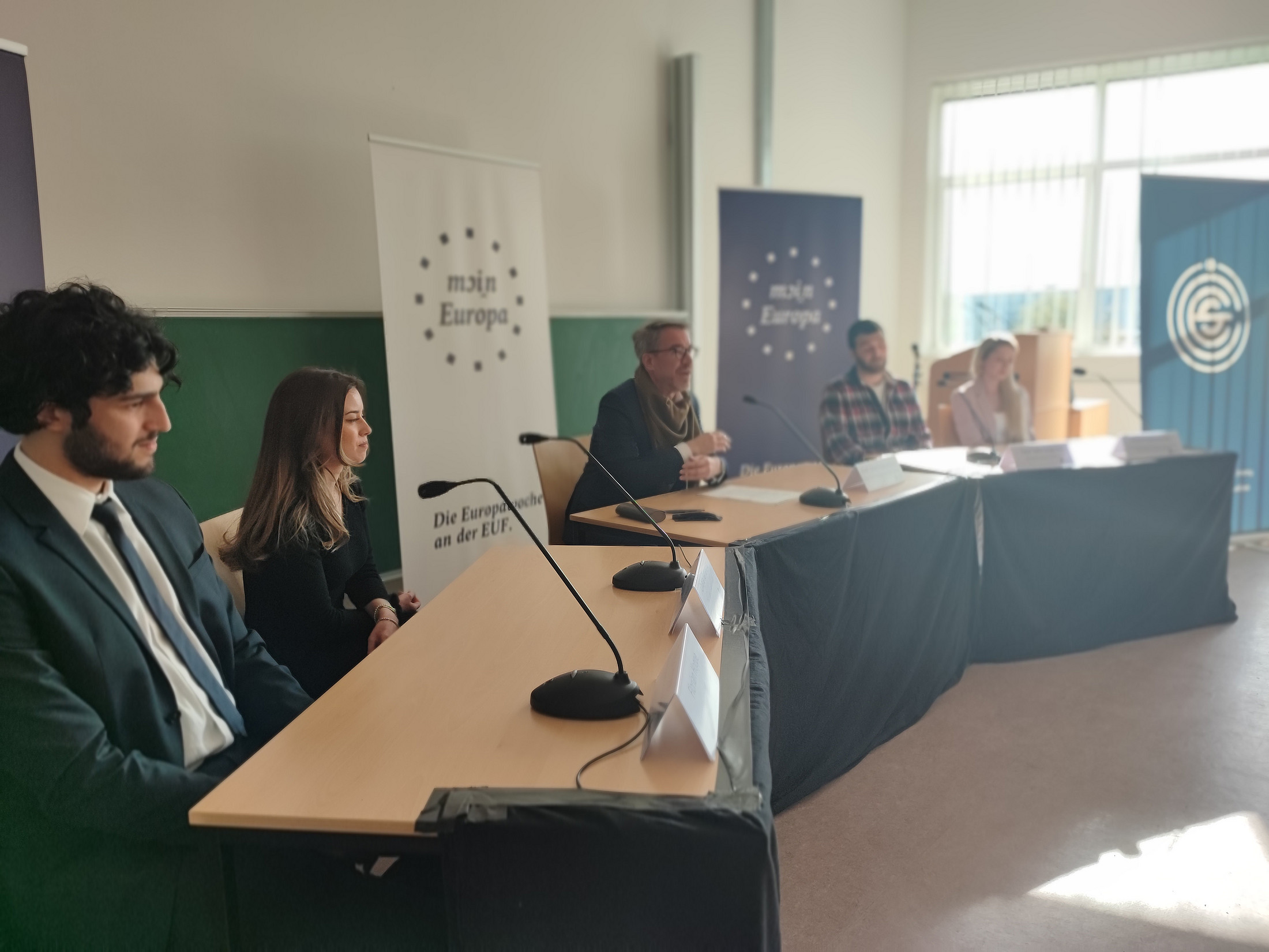
European Week 2026 will take place from May 4 to 8 in cooperation with European Future Talks at the invitation of the European Wasatia Graduate School for Peace and Conflict Resolution.
This year, the motto “Freedom and Disinformation” is at the heart of Europe Week — a pressing and timely issue, as it challenges the very foundations of our democracy. At a time when digital technologies, artificial intelligence, and targeted information campaigns are influencing public debate, striking a balance between freedom of expression and protection against manipulation is becoming increasingly difficult. Europe Week highlights this tension through various formats, encourages critical reflection, and seeks solutions together.
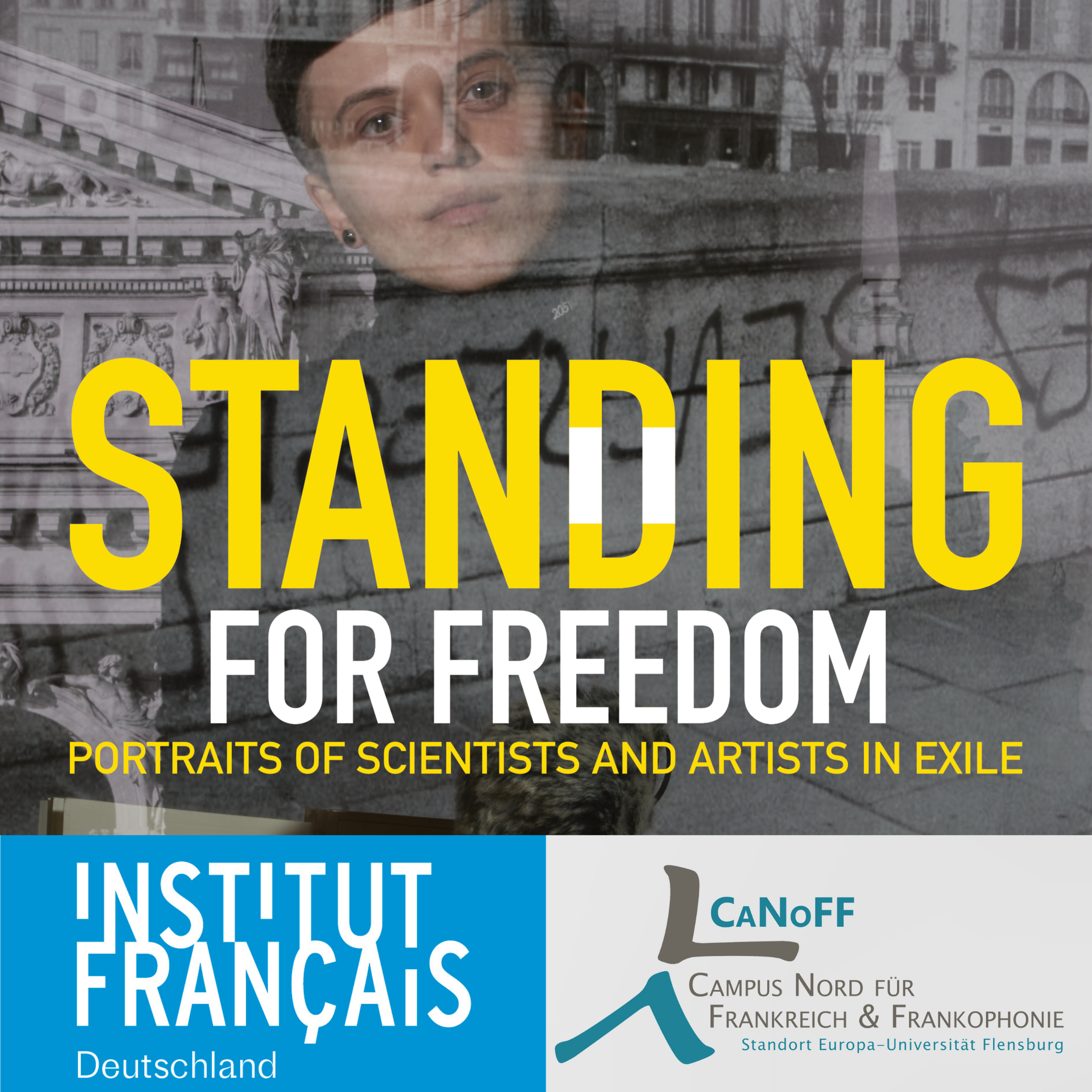
All day | Exhibition "Standing for Freedom - Poser pour la liberté"
What: Exhibition
For whom: University members an general public
When: April 22 - May 12 | all day
Where: HEL Foyer
Language: English, French
Organisation: Northern Campus for France and francophony (CaNoFF)
Cooperation partner: Institut français d’Allemagne (Berlin)
What does it mean for a scientist to be forced to leave their home country? What is the state of academic freedom and scientific exile in Europe? These are the themes of the English- and French-language exhibition “Standing for Freedom – Poser pour la liberté,” which centers on fifteen portraits of scientists who were forced into exile. The exhibition’s thematic scope is broad, ranging from the history of scientific asylum to researchers in mortal danger, science in exile, and active forms of solidarity. The exhibition emerged at the intersection of scientific research and art and is the result of a collaboration between Pascale Laborier, Pierre-Jérôme Adjedj, and the individuals portrayed, who played a key role in its design.
On May 6, the Institute of Physics and its Didactics and its History is organizing a guest lecture (German only) on the topic “Scientists under National Socialism – Stay or Emigrate?” by Dr. Stefan Wolff (Research Institute for the History of Technology and Science at the Deutsches Museum München).
9:15 am | European Future Talks

What: Panels & exchange
For whom: University members and general public
When: Monday, May 4 | between 9:15 am - 12:00 pm
Where: TAL 007
Language: English/German
Organisation: European Future Talks together with the EUF Department for European and International Affairs & European Wasatia Graduate School for Peace and Conflict Resolution
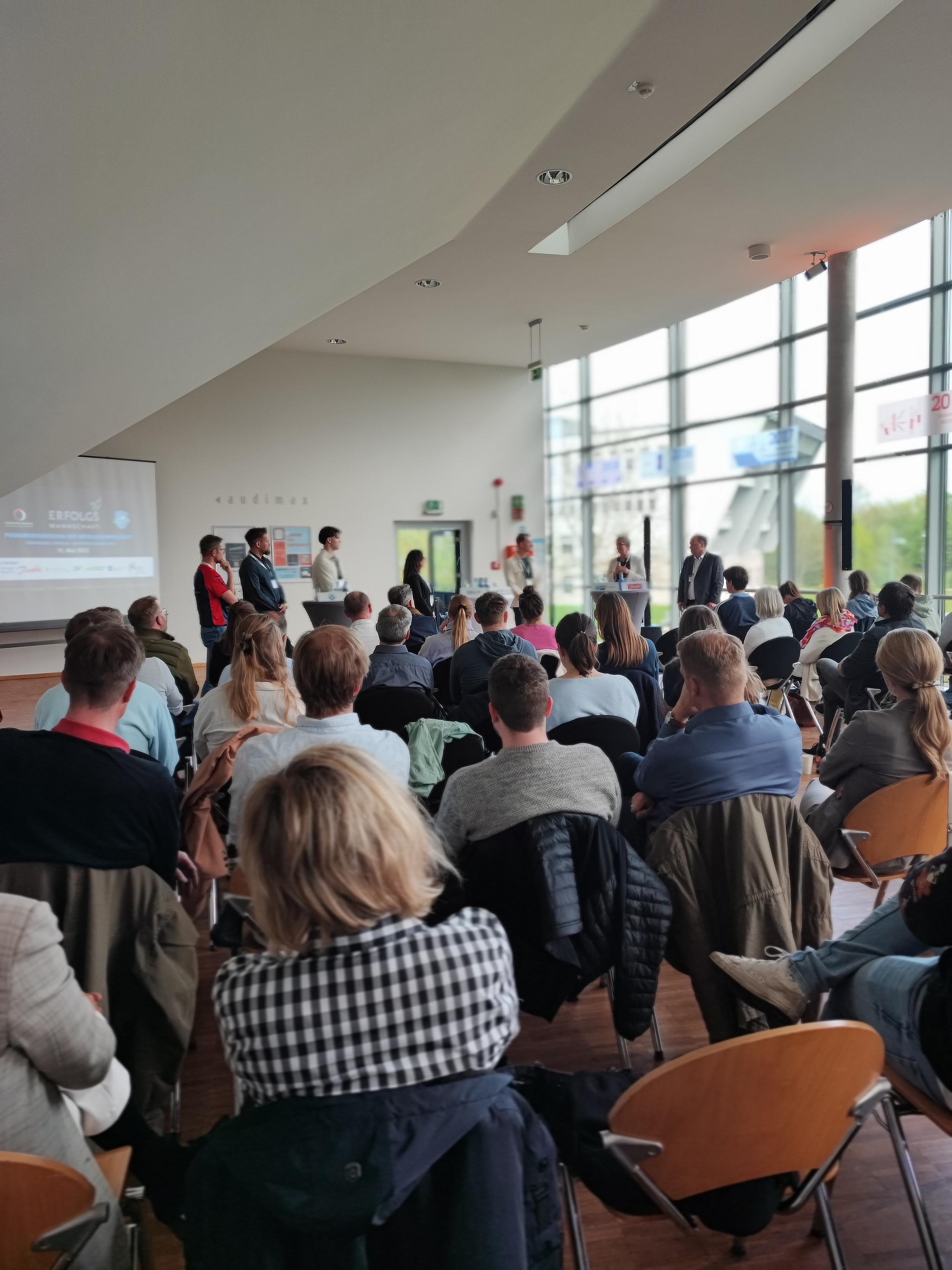
Europe Week 2026 will host this year's European Future Talks, an initiative of Dr. Christian Gsodam, Principal Advisor for Strategic Communication and Planning in the European Union’s External Action Service. The European Future Talks promote European dialogue between politics, academia, and society:
Freedom of expression and information in Europe - Building democracy based on human dignity
There is a delicate balance at the heart of every liberal democracy: how to protect free speech and information while safeguarding human dignity and democratic stability. Across Europe, debates have intensified as hate speech and polarization test the limits of lawful expression. Powerful tech companies increasingly shape public discourse through opaque algorithms driving social media. The use and impact of artificial intelligence is growing exponentially. At the same time, there are concerns about overly intrusive state regulation that, in seeking to curb harms, may inadvertently restrict legitimate dissent and critical voices.
Europe’s democracy is under pressure. More than that, it is actively attacked by foreign information manipulation and interference, as well as coordinated disinformation campaigns of authoritarian systems using technology and practices designed to undermine trust, distort public debate, and weaken democratic institutions.
The European Future Talk in Flensburg will reflect on how European democracy can protect itself and human dignity against manipulation and abuse while upholding fundamental rights and ensuring that freedom of expression and information remains both robust and responsibly exercised in the digital age.
2:00 pm | The Fake News Workshop
What: Workshop
For whom: University members
Speaker: Lennard Friedrichs, Tristan Thietz
When: Monday, May 4 | 2:00 - 3:30 pm
Where: RIG 717
Lnguage: German
Organisation: Seminar für Medienbildung, Projekt Digital Learning Campus
Registration: If possible, register upfront to facilitate planning: https://dlc.sh/lernangebot/6724, spontaneous participation is also welcome
Der Workshop richtet sich an Studierende und Kolleg*innen aus Forschung, Lehre und Verwaltung, die mehr über Fake News lernen möchten, insbesondere darüber, wie Fake News heutzutage mithilfe von KI erstellt werden und wie man sie erkennt. Eine Auswahl von Fake-News mit Bezug zu Europa bzw. zur EU kontextualisiert den Workshop und macht die Relevanz des Themas für politische und gesellschaftliche Europa-Diskurse nachvollziehbar. Darüber hinaus werden Faktenchecker-Tools der EU vorgestellt.
4:15 pm | EUCS Seminar: Politics of Truth in the Age of AI
What: Seminar
For whom: University members
Speaker: Prof. Dr. Thomas Szanto
When: Monday, May 4 | 4:15 - 5:45 pm
Where: HEL 067
Language: English
Digital lifeworlds, and AI in particular, create historically unprecedent possibilities for spreading disinformation and misinformation. But is there really a moral right to truth in the realm of politics? Drawing on Kirkegaard, Nietzsche, and Arendt, among others, Harvard philosopher Mathias Risse challenges this idea and argues that although there actually is no comprehensive right to truth, truthfulness in the public sphere still bears significant value. In this seminar, we will reconstruct and critically discuss Risse’s argument. Except reading the chapter (see below), no prior or specialized knowledge is required for participation.
Risse, Mathias (2023): Political Theory of the Digital Age. Where Artificial Intelligence Might Take Us. Chap. 4: Truth Will Not Set You Free: Is There a Right to It Anyway? Elaborating on the Work Public Reason Does In Life 2.0 Cambridge: Cambridge University Press, S. 73-95.
All university members are welcome, even if they haven’t read the material in advance (if you’re interested in the literature, please contact europawoche-PleaseRemoveIncludingDashes-@uni-flensburg.de).
All day | Exhibition "Standing for Freedom - Poser pour la liberté"
What: Exhibition
For whom: university members an general public
When: 22 April - 12 May | all day
Where: HEL Foyer
Language: English, French
Organisation: Northern Campus for France and francophony (CaNoFF)
Cooperation partner: Institut français d’Allemagne (Berlin)
What does it mean for a scientist to be forced to leave their home country? What is the state of academic freedom and scientific exile in Europe? These are the themes of the English- and French-language exhibition “Standing for Freedom – Poser pour la liberté,” which centers on fifteen portraits of scientists who were forced into exile. The exhibition’s thematic scope is broad, ranging from the history of scientific asylum to researchers in mortal danger, science in exile, and active forms of solidarity. The exhibition emerged at the intersection of scientific research and art and is the result of a collaboration between Pascale Laborier, Pierre-Jérôme Adjedj, and the individuals portrayed, who played a key role in its design.
On May 6, the Institute of Physics and its Didactics and its History is organizing a guest lecture (German only) on the topic “Scientists under National Socialism – Stay or Emigrate?” by Dr. Stefan Wolff (Research Institute for the History of Technology and Science at the Deutsches Museum München).
Cancelled: 10:00 am | Workshop: Anti-Semitism on TikTok – Challenges and Possible Responses in Educational Settings
What: Workshop
Title: Anti-Semitism on TikTok – Challenges and Approaches in Educational Settings
For whom: University members
Speaker: Anne Frank Bildungsstätte
When: Tuesday, May 5 | 10:00 am–2:00 pm
Where: Online
Language: German
Organization: Center of Excellence for Teaching and Learning – University Didactics
Registration required
Der Workshop legt den Schwerpunkt auf rechtsextreme und verschwörungsideologische TikTok-Formate und richtet sich primär an pädagogische Fachkräfte und bietet einen fundierten Einstieg in das Thema Antisemitismus auf TikTok. Im Zentrum steht die Auseinandersetzung mit aktuellen Erscheinungsformen antisemitischer Narrative und Bildwelten auf der Plattform – und den Herausforderungen, die sich daraus für pädagogisches Handeln ergeben.
Neben einer Einführung in Funktionsweise, Struktur und Spezifika von TikTok werden zentrale Mechanismen digitaler Radikalisierung und antisemitischer Kommunikation im Social-Media-Kontext beleuchtet. Dabei liegt der Fokus auf der Frage, wie pädagogische Fachkräfte sowohl im digitalen als auch im analogen Raum handlungssicher agieren und Jugendlichen reflektierte Zugänge zu TikTok-Inhalten ermöglichen können.
4:00 pm | Guided City Tour: The Diversity of Art in Flensburg’s Public Spaces — Local and European Dimensions
What: City tour
For whom: University members and the general public
Presenter: Gregor Dittmann
When: Tuesday, May 5 | 4:00–5:30 pm
Where: Starting point at Museumsberg (entrance to Heinrich-Sauermann-Haus) (approx. 2.5 km)
Language: German
Registration: gregor.dittmann-PleaseRemoveIncludingDashes-@studierende.uni-flensburg.de
Wer sich mit offenen Augen durch die Flensburger Innenstadt bewegt entdeckt sie überall: Kunst im öffentlichen Raum; an einigen Stellen subtil und versteckt, an anderen Orten als großflächige Wandmalerei nicht zu übersehen. Doch welche Kunstschaffenden, Initiativen und Projekte stecken dahinter? Begebt Euch mit mir auf einen interaktiven Stadtspaziergang von circa 2,5km durch die Flensburger Innenstadt: Wir entdecken und diskutieren gemeinsam ausgewählte Kunstwerke im öffentlichen Raum. Es sind Arbeiten von lokalen Kunstschaffenden dabei sowie Perspektiven aus verschiedenen Teilen Europas und der Welt.
Gregor Dittmann (er/ihm, they/them) studiert im Bachelor „Transkulturelle Europastudien“ an der Europa-Universität in Flensburg, der Université de Strasbourg und der Universidad de Málaga. Sein großes Interesse gilt der bildenden Kunst, ihrer wissenschaftlichen Erforschung und musealen Präsentation. Im Rahmen des Studiums setzt er sich mit alternativen Möglichkeiten der kunstgeschichtlichen Forschung sowie experimentellen Vermittlungsformaten auseinander.
All day | Exhibition "Standing for Freedom - Poser pour la liberté"
What: Exhibition
For whom: university members an general public
When: 22 April - 8 May | all day
Where: HEL Foyer
Language: English, French
Organisation: Northern Campus for France and francophony (CaNoFF)
Cooperation partner: Institut français d’Allemagne (Berlin)
What does it mean for a scientist to be forced to leave their home country? What is the state of academic freedom and scientific exile in Europe? These are the themes of the English- and French-language exhibition “Standing for Freedom – Poser pour la liberté,” which centers on fifteen portraits of scientists who were forced into exile. The exhibition’s thematic scope is broad, ranging from the history of scientific asylum to researchers in mortal danger, science in exile, and active forms of solidarity. The exhibition emerged at the intersection of scientific research and art and is the result of a collaboration between Pascale Laborier, Pierre-Jérôme Adjedj, and the individuals portrayed, who played a key role in its design.
On May 6, the Institute of Physics and its Didactics and its History is organizing a guest lecture (German only) on the topic “Scientists under National Socialism – Stay or Emigrate?” by Dr. Stefan Wolff (Research Institute for the History of Technology and Science at the Deutsches Museum München).
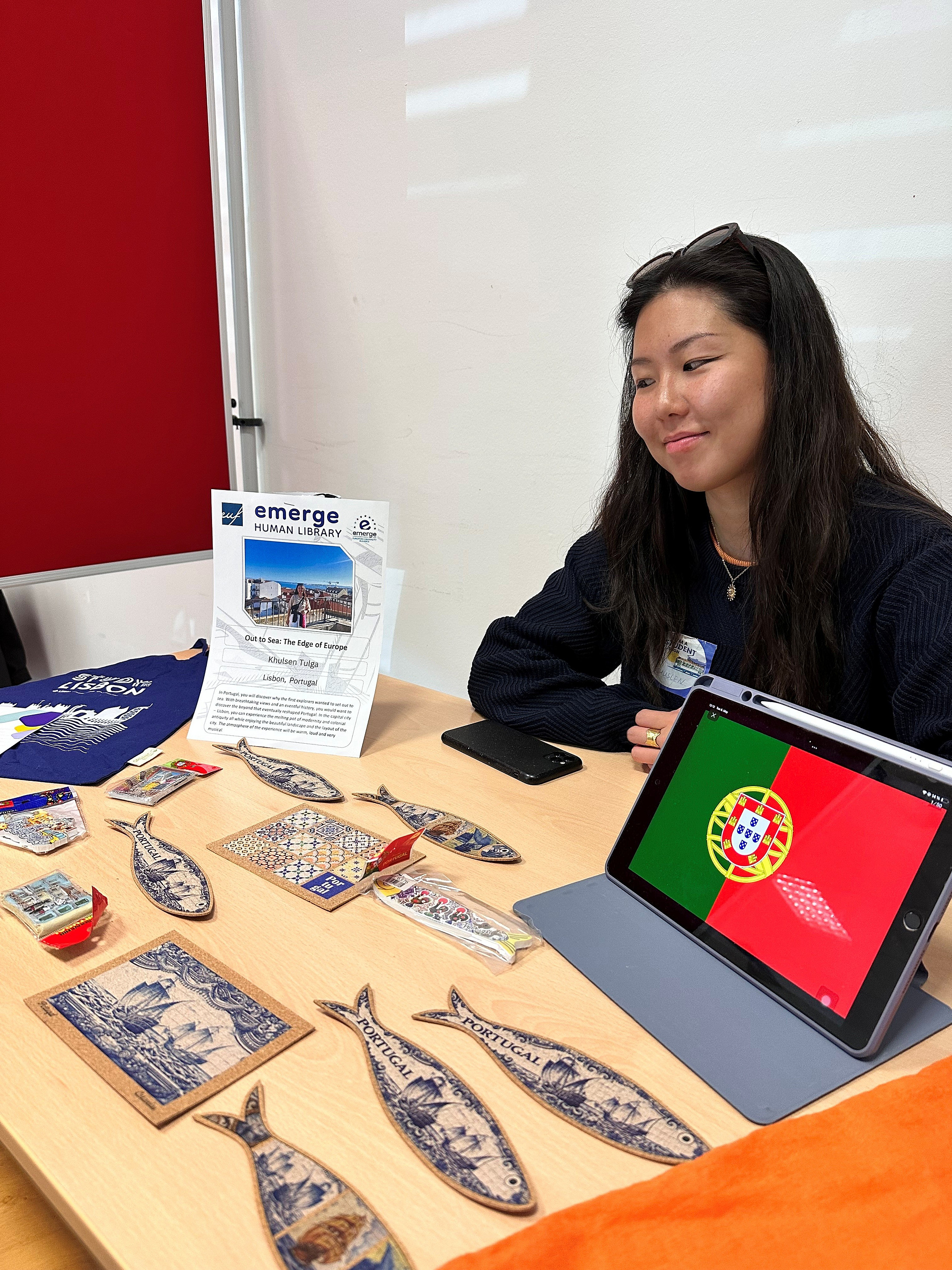
11:30 am | EMERGE Living Library: Freedom and International Experiences
For whom: University members
When: Wednesday, May 6 | 11:30 am - 1:30 pm
Where: HEL 065
Language: German/English
Organisation: European University Alliance EMERGE
In the “EMERGE Living Library” you can explore different stories of our students: Rather than borrowing and reading a book, you can borrow a student's time and listen to their stories of freedom and international experiences, diversity and resilience.
This event is inspired by the Human Library concept. We have applied for official partnership and are awaiting approval.
12:15 pm | AI and mathematics
What: Lecture
For whom: University members and general public
Speaker: Prof. Dr. Hinrich Lorenzen, PD Dr. Merlin Carl
When: Wednesday, May 6 | 12:15 - 1:15 pm
Where: TAL 007
Language: German
Organisation: Department of Mathematics
Künstliche Intelligenz, insbesondere große Sprachmodelle, erzielen inzwischen beeindruckende Leistungen in Domänen, die bisher menschlichen Spezialist:Innen vorbehalten waren. Das gilt auch für die Mathematik, und zwar sowohl in der Wettbewerbs- wie auch in der Forschungsmathematik. Im Vortrag werden wir zum einen einen Überblick über die neueren Entwicklungen auf diesem Gebiet geben und zudem die Frage in den Blick nehmen, worin der Beitrag menschlicher Mathematik in Zukunft noch bestehen könnte.
2:00 pm | With compass, map and Immanuel Kant: What does it mean to orient oneself in thought?
What: Lecture/Crash Course
For whom: University members and the general public
Speaker: Leiv Eirik Voigtländer, PhD, studied political science and economics with a focus on political theory and the history of ideas.
When: Wednesday, May 6 | 2:00–4:00 p.m.
Where: EUF Campus, meeting point at the entrance to Tallinn 1 (weatherproof clothing may be required), in case of heavy rain: TAL 007
Language: German
Wie können wir angesichts von Desinformation, vermeintlich alternativen Fakten und pseudowissenschaftlicher Mythenbildung in einer Welt in Veränderung die Orientierung behalten? Inwiefern kann uns unsere Vernunft dabei sozusagen als Kompass dienen? Inwiefern sind wir auf fremde Hilfe angewiesen? Antworten auf solche Fragen finden sich beispielsweise in einem berühmten Aufsatz des Philosophen Immanuel Kant: "Was heißt: Sich im Denken orientieren?" (1786)
In diesem praktisch-diskursiv-theoretischen Crashkurs gehen wir mit Kompass, Karte und Kant einen kleinen Schritt weiter und fragen: Was heißt überhaupt, sich zu orientieren? Und welchen Wert hat unser räumliches Orientierungsvermögen für unser kritisches Denken? Taugt die Orientierungsmetapher noch für heutige Kämpfe um Emanzipation, Aufklärung und Wissenschaft?
4:15 pm | Scientists Under National Socialism – Stay or Emigrate?
What: Lecture & Discussion
Title: Scientists Under National Socialism – Stay or Emigrate?
For whom: University members and general public
Speaker: Dr. Stefan Wolff (Research Institute for the History of Technology and Science at the Deutsches Museum München).
When: Wednesday, May 6 | 4:15–5:45 pm
Where: TAL 007
Language: German
Organization: Institute for Physics and its Didactics and its History
Im Nationalsozialismus wurden nicht nur politische Gegner verfolgt, sondern selbst im Fall bekundeter Loyalität auch Menschen, die nach einer willkürlichen Definition der „jüdischen Rasse“ zugerechnet wurden. Diese durften - bis auf Ausnahmen - bereits seit April 1933 nicht mehr im öffentlichen Bereich beschäftigt werden. Dazu zählten alle Universitäten sowie fast alle Forschungseinrichtungen außerhalb der Industrie. Insoweit kam es 1933 zu einer ersten großen Entlassungswelle, die sich in den folgenden Jahren fortsetzte und nach dem Pogrom vom November 1938 nochmals einen Höhepunkt erreichte. Seit 1933 stellte sich den Betroffenen (und vielleicht nicht nur ihnen) die Frage, ob es möglich und sinnvoll war zu bleiben, also abzuwarten oder besser zu emigrieren, wobei sie sich dann mit der Frage nach dem Wohin auseinandersetzen mussten. Wir wollen dies anhand einiger biographischer Beispiele aus der Physik diskutieren.
11:55 am | (Bündnis) Eine Welt in Flensburg
What: Keynote presentation
For whom: University community and the general public
Speaker: Dr. Alexandra Berger
When: Wednesday, May 6 | 11:55 a.m. – 12:05 p.m.
Where: HEL, seminar corridor, ground floor
Language: German
Organization: CREST
Bei „entwicklungspolitischer Arbeit“ und „Eine-Welt-Themen“ stellen sich die meisten wohl Tätigkeiten in einem Land des Globalen Südens vor. Doch auch hier bei uns vor Ort, in Flensburg, findet Eine-Welt-Arbeit statt. Der Beitrag gibt einen Einblick in entwicklungspolitische Themen und globale Bezüge in Flensburg.
All day | Exhibition "Standing for Freedom - Poser pour la liberté"
What: Exhibition
For whom: university members an general public
When: 22 April - 12 May | all day
Where: HEL Foyer
Language: English, French
Organisation: Northern Campus for France and francophony (CaNoFF)
Cooperation partner: Institut français d’Allemagne (Berlin)
What does it mean for a scientist to be forced to leave their home country? What is the state of academic freedom and scientific exile in Europe? These are the themes of the English- and French-language exhibition “Standing for Freedom – Poser pour la liberté,” which centers on fifteen portraits of scientists who were forced into exile. The exhibition’s thematic scope is broad, ranging from the history of scientific asylum to researchers in mortal danger, science in exile, and active forms of solidarity. The exhibition emerged at the intersection of scientific research and art and is the result of a collaboration between Pascale Laborier, Pierre-Jérôme Adjedj, and the individuals portrayed, who played a key role in its design.
On May 6, the Institute of Physics and its Didactics and its History is organizing a guest lecture (German only) on the topic “Scientists under National Socialism – Stay or Emigrate?” by Dr. Stefan Wolff (Research Institute for the History of Technology and Science at the Deutsches Museum München).
2:00 pm | Workshop: My Data Belongs to Me
What: Workshop
Title: My Data Belongs to Me – Tips for Better Data Protection on Android Smartphones
For whom: University members and the general public
Speaker: Tim Lüdeke
When: Thursday, May 7 | 2:00–3:30 pm
Where: StudioPlus/Camelot
Language: German
Organized by: i2l (Innovation Learning Lab)
Registration: Walk-ins are welcome, but please send an email to i2l-PleaseRemoveIncludingDashes-@uni-flensburg.de to help us plan
Der Workshop soll Teilnehmende für das Thema Datenschutz und seine Wichtigkeit im täglichen Umgang mit dem Android-Smartphone sensibilisieren und handlungspraktische Tipps zu folgenden Themen geben:
- Wie kann ich Datensammelei erkennen und mich gegen aufdringliche Apps oder Tracking wehren?
- Welche Apps kann ich kostenfrei auf dem Smartphone nutzen, ohne (zu sehr) mit meinen Daten zu bezahlen? Welche Alternativen zu Angeboten von Google & Co. gibt es dafür?
- Was kann ich noch an meinem Smartphone einstellen, um möglichst eine gute Balance zwischen Datenschutz und Komfort zu erreichen?
Neben einigen erfahrungsbasierten Empfehlungen ist außerdem angedacht, am Ende einen kleinen Austausch unter den Teilnehmenden anzuregen und natürlich die Möglichkeit zu geben, Fragen zu stellen.
[Translate to 2-Englisch:] 15:30 Uhr | Förderung der psychosozialen Gesundheit in Bildungseinrichtungen und Familien
What: Promoting psychosocial well-being in educational institutions and families: Introducing the Haus der Familie in Flensburg.
For whom: University members
Wann: Thursday, May 7 | 3:30 pm
Where: OSL 249
Language: English
Organisation:
Cooperation partner: Haus der Familie, Flensburg
In addition to a brief introduction to the Hauses der Familie in Flensburg, the event will provide insights into specific projects, such as “Kidstime.” The practical focus and the experiences gained from working with families and children are both enriching and informative for students and faculty members.
10:00 am | Workshop: Understanding and using AI tools while remaining in control
What: Workshop
Title: Understanding and Using AI Tools While Remaining in Control
For whom: University community
Speaker: Matthias Gramm
When: Tuesday, May 12, 2026 | 10:00 – 11:30 am
Where: RIG 401
Language: German
Organization: Vocational Training Institute for Work and Technology (biat)
Anmeldung erforderlich: https://dlc.sh/admin/localoffers/6744?lz=112
In diesem Workshop erkunden wir die Möglichkeiten verschiedener KI-Tools. In einer praktischen Übung erstellen wir ein kurzes Fake-Video und reflektieren anschließend die Ergebnisse auf glaubhafte Wirkung.
Darauf aufbauend lernen wir weitere KI-Anwendungen kennen, diskutieren sinnvolle Einsatzmöglichkeiten sowie Risiken wie Meinungsbeeinflussung und legen einen Fokus auf einen bewussten Umgang mit persönlichen Daten. Dabei wollen KI-Tools kennenlernen und bevorzugen, die möglichst wenige Informationen vom Nutzenden abrufen, DSGVO konform sind und sinnvolle Alternativen zu bereits bekannteren KI-Tools darstellen.
Für die Teilnahme ist ein eigener Laptop sowie die Zugriffsmöglichkeit auf seine Email-Adressen empfehlenswert. Bei Bedarf kann ein Leihlaptop gestellt werden.
3:00 pm | Workshop: Prebunking Interventions on the Communication Strategies of New Right Actors for the Classroom
What: Workshop
Title: „Immun gegen rechts? Prebunking Interventionen zu Kommunikationsstrategien der Akteure der neuen Rechten für den Unterricht“
For whom: University members and (prospective) teachers
Speaker: Jan Hinnerk Thür
When: Tuesday, May 12, 2026 | 3:00–6:00 pm
Where: RIG 815 and online (hybrid event)
Language: German
Organizers: Seminar for Media Education, State Program “Future School in the Digital Age,” and ZfL
Registration required by May 7, 2026, via Formix using event number EUL0492
Social Media, insbesondere TikTok, sind voll von rechten Inhalten zwischen Tradwife und extremistischer Manosphere; und sie erreichen eine Menge Menschen, insbesondere Jugendliche. Die Inhalte rechtspopulistischer Akteure folgen dabei bestimmten Mustern und Strategien, um Fakten zu verzerren, große Reichweiten zu generieren und Meinungen zu manipulieren und zu verschieben. Wenn man diese Strategien aber kennt, verlieren sie ihre Effektivität. Der Ansatz Prebunking zielt darauf ab, nicht konkrete Falschmeldungen HINTERHER zu korrigieren (DEbunking), sondern Kommunikations- und Argumentationsstrategien zu erproben und zu vermitteln, sodass bei Kontakt mit rechtspopulistischen Inhalten schon eine gewisse „Immunisierung/Impfung“ (eng. Innoculation) vorhanden ist.
Partners
Europe Week 2026 will host this year's European Future Talks at the invitation of EUF's European Wasatia Graduate School for Peace and Conflict Resolution.

Dr.Isabella Tegethoff
Advisor for European and International Affairs
- Phone
- +49 461 805 2970
- isabella.tegethoff-PleaseRemoveIncludingDashes-@uni-flensburg.de
- Building
- Gebäude Dublin
- Room
- DUB 212
- Street
- Campusallee 3
- Post code / City
- 24943 Flensburg