SEDev Programme Contents
The specialisation "Sustainable Energy and Development (SEDev)" is made up of three subject fields:
- Energy planning and systems analysis with emphasis on integrating renewable energy
- Energy planning and management with a focus on implementation, stakeholders, projects and policies
- Energy transformation as part of international development cooperation
The Module Catalogue of the Sustainable Energy Master Program offers information regarding all the modules offered during the study. The English translation of the module catalogue is unofficial.
Presemester Course Overview

Business Economics
Energy Economics
Micro and Macro Economics
Energy Modelling
Academic Writing
Research Methods
German Language (A1 Level)
1st Semester
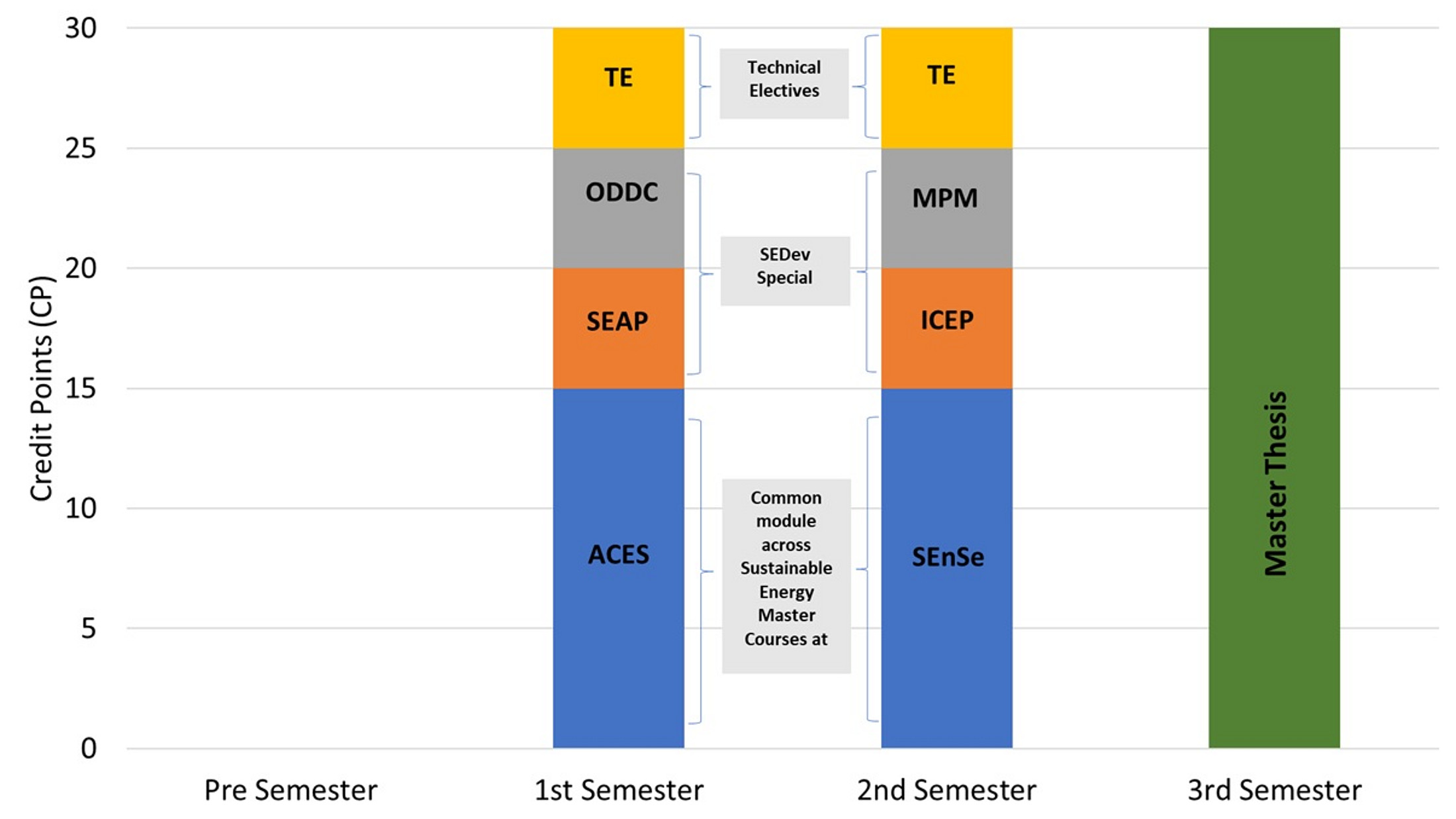
After successfully completing the pre-semester, students will start their first semester together with other students of the sustainable energy courses. Students are required to complete at least 30 Credit Points (CP). The typical courses offered this semester are:
Module ACES: Analysis and Complexity of Energy Systems (15 CP)
In this module, students acquire fundamental knowledge in the modelling and optimisation of sustainable energy systems. They analyse energy systems in terms of sustainability, develop supply strategies, and explore integration options for renewable energy sources.
The module is compulsory for all specialisations and consists of three sub-modules with different courses:
- ACES 1
- ACEC 2
- ACES 3 a-d
Module SEAP: Sustainable Energy Access Planning (5 CP)
Students develop energy plans for regions with insufficient energy infrastructure and use GIS methods to plan sustainable energy access. They learn to process geographic data and facilitate participatory planning processes.
This module is an elective in the "Development" track and includes the following possible courses:
- Sustainability Energy Access Planning
Module ODDC: Organisations and Diversity in Development Cooperation (5 CP)
This module enhances intercultural competence and leadership skills in the context of international development cooperation. Students develop abilities in teamwork, conflict management, and intercultural communication.
This module is an elective in the "Development" track and includes the following possible courses:
- Organisations and Diversity in Development Cooperation
Technical Elective Modules (5 CP)
For technical elective, a range of options are available for the students, which are offered by EUF and HS Flensburg. Students are required to take at least one elective module of their choice to earn 5 Credit Points.
The modules TE1 - TE8 are technical electives in all specialisations and include the following possible courses:
- Machinery components
- Advanced Powerplant Technology
- Controller design for wind turbines and wind farms
- Elektrochemische Energietechnik (Electrochemical Energy Technology)
- Advanced engineering mathematics
- Energieeffizienz versorgungstechnischer Systeme (Energy Efficiency in Industrial Utilitys)
- Grid Integration
- Market integration and commercial optimisation
- Wind Energy Planning and Applied Geoinformatics
- Tower and rotor structures
Note: A course may not be counted multiple times across different module areas. Courses are generally offered annually; however, new courses may be added or existing ones may be discontinued. Please always check the current course schedules.
2nd Semester
After successfully completing the first semester, students will start their 2nd semester together with other students of the sustainable energy courses. Students are required to complete at least 30 Credit Points (CP). The typical courses offered this semester are:
Module SEnSe: Sustainable and Just Energy System Solutions (15 CP)
This module provides an overview of the fundamentals and measures of energy and climate policy in the context of sustainable and equitable energy systems. Students develop strategies at national, international, and local levels while deepening their knowledge of qualitative methods in energy systems research.
The module is compulsory for all specialisations and consists of four sub-modules, of which three must be completed:
- SEnSe 1
- SEnSe 2
- SEnSe 3,
- SEnSe 4a-d
Module ICEP: International Community Energy Project (5 CP)
Students plan and support community energy projects and conduct field studies in international teams. They present their findings to the local population and co-author research reports.
This module is an elective in the "Development" track and includes the following possible courses:
- International Community Energy Project
Module MPM: Markets and Project Management (5 CP)
In this module, students analyse international energy markets and learn fundamental project management methods. They develop projects and present their results professionally.
This module is an elective in the "Development" track and includes the following possible courses:
Markets and Project Management
Technical Electives (5 CP)
For technical elective, a range of options are available for the students, which are offered by EUF and HS Flensburg. Students are required to take at least one elective module of their choice to earn 5 Credit Points.
The modules TE1 - TE8 are technical electives in all specialisations and include the following possible courses:
- Machinery components
- Advanced Powerplant Technology
- Controller design for wind turbines and wind farms
- Elektrochemische Energietechnik (Electrochemical Energy Technology)
- Advanced engineering mathematics
- Energieeffizienz versorgungstechnischer Systeme (Energy Efficiency in Industrial Utilitys)
- Grid Integration
- Market integration and commercial optimisation
- Wind Energy Planning and Applied Geoinformatics
- Tower and rotor structures
Note: A course may not be counted multiple times across different module areas. Courses are generally offered annually; however, new courses may be added or existing ones may be discontinued. Please always check the current course schedules.
Module TH: Master Thesis (30 CP)
Once students have completed necessary modules and earned 60 credit points, they can enroll for master thesis
The Master’s thesis marks the conclusion of the programme and allows students to independently address a complex scientific question. They apply the methods learned during their studies, develop a comprehensive research concept, and present their findings.
Students can take a master thesis topic of their choice and can work in collaboration with governmental organisation, development organisation, industry, companies or on their own to work on for 4-5 months.
At the end of their thesis, students are required to submit a scientific paper-style thesis within 8000 words.
Overall Credit Points Distribution