The slide trough according to Agnes Pockels
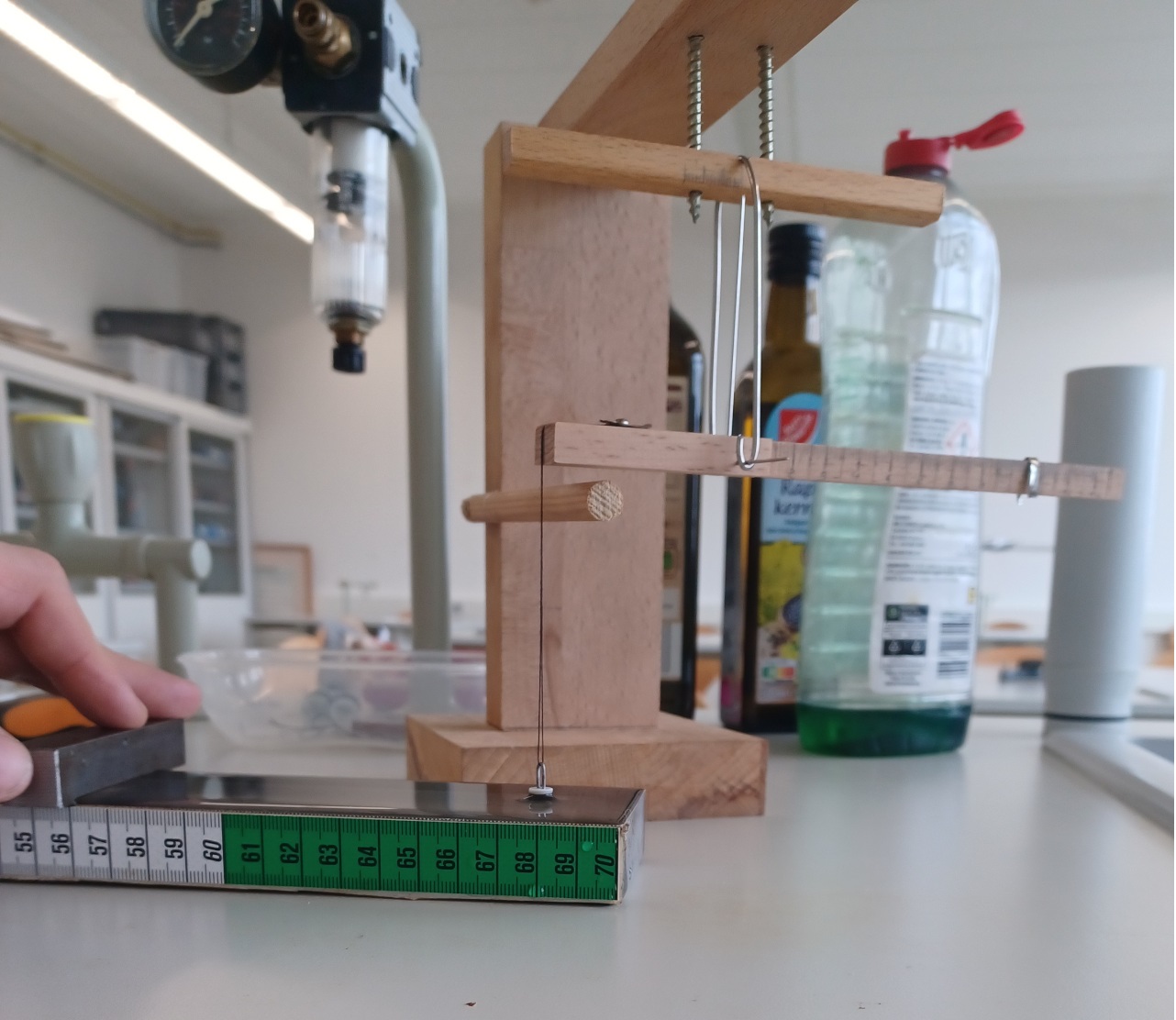
Agnes Pockels developed her instrument and carried out her measurements in her private rooms at the end of the 19th century. With her experiments, she made a significant contribution to the study of the surface tension of water, in particular investigating how this behaved when the water was polluted in a controlled manner.
For these experiments, she used a metal trough filled to the brim with water. At one end, a small porcelain knob touched the surface of the water, which was suspended from one end of a running weight balance (a type of asymmetrical beam balance). On the other side of the pivot point was the running weight, which was slowly pushed away from the pivot point. This increasingly lifted the knob, forming a lamella of water that eventually broke off - precisely this point was determined.
The water can be deliberately contaminated with a drop of oil or oleic acid, the surface can then be reduced further and further by moving a metal block, and the departure at a fixed position of the sliding weight can be determined again.
further reading
Lütje, G. (2025). Agnes Pockels' Arbeiten zur Oberflächenspannung: Physikalische und wissenschaftshistorische Analyse zu ausgewählten Experimenten mit der Schieberrinne. (BA-Thesis). Europa-Universität Flensburg,
Pockels, Agnes (1892): On the relative contamination of the water- surface by equal quantities of different substances. Nature 46, 418.
Pockels, Agnes (1899): Untersuchung von Grenzflächenspannungen mit der Cohäsionswage. Annalen der Physik 67, 668.
Rayleigh. (1891). Surface Tension. Nature, 43(1115), 437-439. doi:10.1038/043437c0
Sella, Andrea (2015): Pockels’ trough. Chemistry world, https://www.chemistryworld.com/opinion/pockels-trough/8574.article#commentsJump