Ohm's Torsion Balance and his Second Law on Contact Electricity
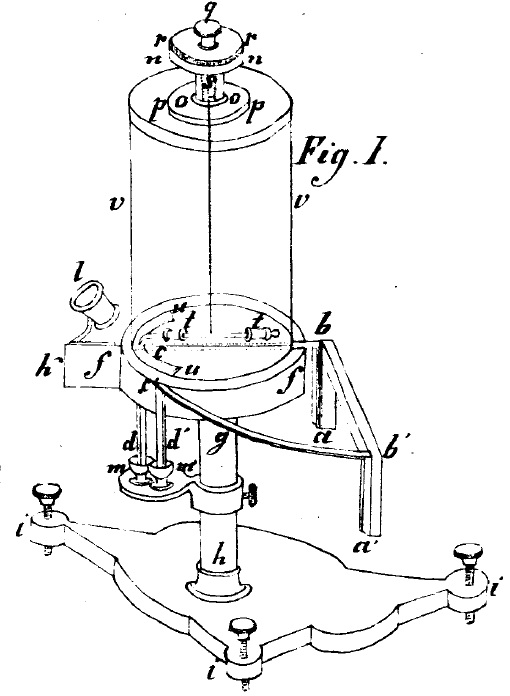
Ohm's torsion balance was used by Georg Simon Ohm in 1826 to determine the dependency of currents and conductivity we now know as Ohm's law. A thermocouple made of copper and bismuth serves as the voltage source, with the bismuth bracket connected to two copper plates. One copper plate passes through the torsion balance, above which hangs a magnet with a piece of wire attached to one end as a pointer. The other sheet is guided past the balance so that both sheets end close to each other. The ends are immersed in vessels filled with mercury and the circuit is closed by immersing the ends of a wire of variable length used for the measurement in both vessels.
The contact points of the thermocouple are located in two metal vessels, one containing a mixture of ice and water, the other containing water brought to a boil with a burner. This ensures a fixed temperature difference and thus a fixed voltage. In the torsion balance, the magnet hangs on a hook, and the pointer at the end of the magnet is located above a scale. The exact position of the pointer can be read using a magnifying glass located outside the balance. When the needle is deflected by an electric current, it is turned back to its original position using the torsion micrometer. The force required to do this corresponds to the torsion of the thread, which can be read on the micrometer.
further reading
Ohm, G. S. (1826). "Bestimmung des Gesetzes, nach welchem Metalle die Contaktelektricität leiten, nebst einem Entwurfe zu einer Theorie des Voltaischen Apparates und des Schweiggerschen Multiplicators." Journal für Chemie und Physik 46: 137-166.
Engels, W., & Rieß, F. (2022). Die Drähte des Georg Simon Ohm (1789–1854). In P. Heering (Ed.), Kanonische Experimente der Physik: Fachliche Grundlagen und historischer Kontext (pp. 89-107). Berlin, Heidelberg: Springer Berlin Heidelberg.