Vocational School Teaching (Industrial/Technical Sciences) – Master of Vocational Education (M.Ed.)

Become a teacher for vocational schools in technical subjects!

Contents

Shape the future: study how to teach learners and trainees in various technical subjects – modern and innovative

You want to share your passion for electrical, automotive, information, or metal technology? Already have a bachelor’s degree in one of these fields? Then the teaching degree for vocational schools in industrial-technical subjects is a perfect fit for you.

Here, you’ll teach at various vocational school types – from vocational schools to vocational high schools – working with both young people and adults in your technical field. You won’t just help combat the skilled labor shortage; you’ll also play a key role in shaping your students’ personal growth.

With the M.Ed. Vocational School Teaching (Industrial / Technical Sciences), designed by the Institute of Vocational Education and Training, Work and Technology (biat), we’ll support you on this journey. The master’s program consists of three parts:

What can you expect?

  • Seminars
  • Lectures
  • Workshop projects
  • Lab exercises
  • Research in companies
  • Excursions
  • Classroom observations
  • Teaching your own classes
  • State-of-the-art workshops
  • A supportive environment based on mutual respect
  • Individual mentoring
  • Chance to receive a Germany Scholarship to fund your studies
  • Contacts with universities, vocational training centers, chambers, and companies

With up-to-date knowledge and plenty of hands-on experience, we’ll prepare you for a teaching career at vocational schools in industrial-technical sciences. Curious? Find out more here!

The degree program at a glance

Degree

Master of Education (M.Ed.)

Duration

4 semesters (= 2 years)

Study start

Fall semester (= September)

Languages

German

Application period

May 15 to August 31

Tuition fees

None, but a semester fee is payable each semester

Type of course

Full time

Internship

Mandatory

Here you’ll find everything you need to know about applying, admission, and deadlines

To the info

Want a first impression?

Tip: This video is also available on YouTube with auto-translated English subtitles!

Course content: What this degree program is all about

  • Content relating to your technical specialization, for example:
    • Current and future developments in electrical engineering
    • The professional field of automotive technology and the occupational profiles in industrial and artisan automotive careers
    • Subject-specific didactic requirements for training and continuing education in information technology
    • The emergence and evolution of skilled work in metal technology
  • Content relating to the subject “Vocational Education”, for example:
    • The duality of company and school
    • Key concepts such as profession, qualification, and competence
    • Structures, forms, and support systems in vocational education
    • Influences and responsibility structures in German vocational training
  • Content relating to your general education subject, for example:
    • Core concepts of optics and electricity in the subject of physics
    • The political system in Germany in the subject of economics/politics
    • Solid math knowledge with application, IT, and didactic references in the subject of mathematics
  • Practical experiences in school:
    • What does the daily teaching routine look like in vocational schools?
    • What challenges will you encounter there, and how do you handle them?
    • How do you plan and conduct action-oriented teaching?

Checklist: Is this degree program right for you?

  • You’re interested in:
    • Electrical engineering,
    • Automotive technology,
    • Information technology/computer science,
    • Or metal technology.
  • You enjoy sharing your technical knowledge and experience.
  • You value a strong connection to both workplace and school practice.
  • Standing in front of a class doesn’t intimidate you.
  • You’d rather work with young adults than with small children.
  • You’re good at organizing yourself – even at home, where you’ll handle much of your lesson prep and grading.
  • You’re interested in vocational education and social issues.
  • You’re not afraid to get your hands dirty.
  • You’re looking for a secure job with an attractive salary and career advancement opportunities.
  • You want to always have a contact person for questions and issues during your studies.
  • You appreciate a small program where people know you and provide close support.

Look ahead: Do your dream subjects suit this type of school?

If you want to become a teacher, you can easily plan your studies with the interactive Subject Combination Tool: try out which subjects and types of school you can combine. You'll immediately see which bachelor's and subsequent master's degree programs you need to complete for your chosen type of school, as well as which subjects (your future teaching subjects) you should select when applying. Be sure to check the notes below your selection.

For more details, just click the tiles: both the degree programs and your individual subjects will take you straight to all the information on admission, content, and course structure.

And if you'd like to discuss your subject combination with others, that's no problem either. You can share the link to it at any time. For example, with friends, your family, teachers, or – if you still have questions – Student Guidance and Counseling Service. Please note: all information is provided without guarantee.

Your subject combination for teacher training

Select the type of school and subjects – the order doesn’t matter. If an option is greyed out, you cannot combine it with your choice in the teacher training programme. If you want to choose a different type of school, you can find all the possible school types and subjects available at EUF on our general teacher training page.

Your studies

Bachelor‘s degree program

  • Relevant bachelor's degree required

    To study the M.Ed. in vocational school teaching (industrial/technical sciences), you need a relevant engineering bachelor's degree that matches your planned technical specialization. Our satellite model helps you find a suitable degree program at one of our partner universities in Flensburg, Kiel, or Lübeck. Find out more here.

Master‘s degree program

Programs (your selected subjects)

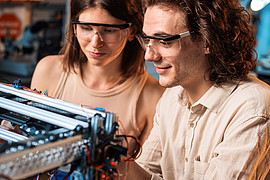
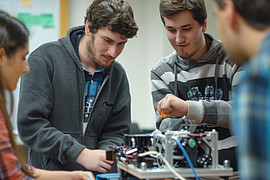
  • Zwei Studierende mit Schutzbrille an einem Tisch. Sie führen gemeinsam ein Experiment zur Robotik durch.

    Electrical Engineering

    Understand electrical engineering and translate it into effective teaching.

    • Vocational School: Industrial and Technical Sciences
    • Admission free
    • Stay abroad:

      Optional

    • Special features:

      Only for the Master of Vocational Education in Industrial/Technical Sciences

  • Eine Weitaufnahme einer Shakespeare Statue aus Stratford-Upon-Avon

    English

    Improve your English speaking skills and bring culture into the classroom.

    • Primary School, Comprehensive School, Secondary School, Special Education, Vocational School: Nutrition and Domestic Science, Vocational School: Industrial and Technical Sciences
    • Admission free
    • Entry requirements:

      Language certificate

    • Stay abroad:

      Mandatory

  • Eine schwarze Tafel mit Mathematischen Formeln.

    Mathematics

    Make mathematical concepts understandable and accessible.

    • Primary School, Comprehensive School, Secondary School, Special Education, Vocational School: Nutrition and Domestic Science, Vocational School: Industrial and Technical Sciences
    • Admission free
    • Stay abroad:

      Optional

  • zeigt eine Lehrkraft mit drei Kindern, beim Assistieren eines Experiments in Laborkitteln und Schutzbrillen

    Physics

    Make physical phenomena understandable and allow students to experience them through experiments.

    • Comprehensive School, Special Education, Vocational School: Industrial and Technical Sciences
    • Admission free
    • Stay abroad:

      Optional

  • eine Weitaufnahme des Europa Parlaments, es wehen die Flaggen der EU Mitglieder in der Luft

    Economy/Politics

    Analyze the economy and politics and explain the connections between them.

    • Comprehensive School, Secondary School, Special Education, Vocational School: Nutrition and Domestic Science, Vocational School: Industrial and Technical Sciences
    • Admission free
    • Stay abroad:

      Optional

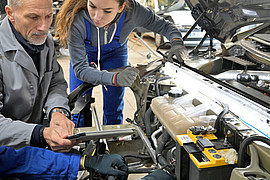
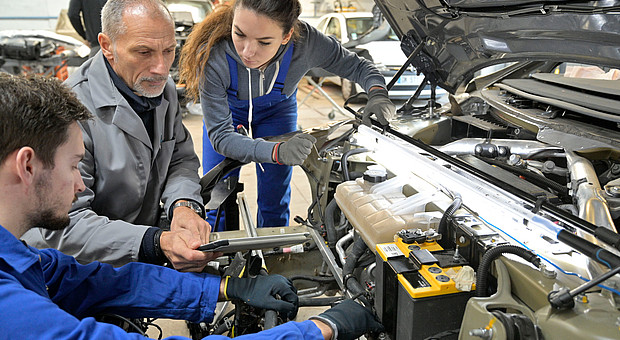
  • Eine Gruppe von Studierenden arbeitet an einem Fahrzeugmotor in einem Seminarraum

    Automotive Engineering

    Dive into automotive engineering and combine hands-on workshop experience with classroom learning.

    • Vocational School: Industrial and Technical Sciences
    • Admission free
    • Stay abroad:

      Optional

    • Special features:

      Only for the Master of Vocational Education in Industrial/Technical Sciences

  • Nahaufnahme eines mikrochips und leiterplatte

    Information Technology

    Develop an understanding of digital systems and how to teach them.

    • Vocational School: Industrial and Technical Sciences
    • Admission free
    • Stay abroad:

      Optional

    • Special features:

      Only for the Master of Vocational Education in Industrial/Technical Sciences 

  • Nahaufnahme eines Lasers auf Metall mit kleinen Funken

    Metal Technology

    Discover metal technology: From materials to modern manufacturing processes.

    • Vocational School: Industrial and Technical Sciences
    • Admission free
    • Stay abroad:

      Optional

    • Special features:

      Only for the Master of Vocational Education in Industrial/Technical Sciences

Want to study more than two subjects?

Learn more

Overview: These are the subjects available at EUF

Click through or filter by your preferred school type.

School types
Gruppenarbeit von Studierenden an einem weißen Tisch in der Mensa der Europa Universität Flensburg.

Vocational Education

Deepen your vocational pedagogical knowledge for your future in teaching.

  • Vocational School: Nutrition and Domestic Science, Vocational School: Industrial and Technical Sciences
  • Admission free
  • Stay abroad:

    Optional

  • Special features:

    Mandatory subject in the Master of Vocational Education

Eine Weitaufnahme einer Shakespeare Statue aus Stratford-Upon-Avon

English

Improve your English speaking skills and bring culture into the classroom.

  • Primary School, Comprehensive School, Secondary School, Special Education, Vocational School: Nutrition and Domestic Science, Vocational School: Industrial and Technical Sciences
  • Admission free
  • Entry requirements:

    Language certificate

  • Stay abroad:

    Mandatory

Eine schwarze Tafel mit Mathematischen Formeln.

Mathematics

Make mathematical concepts understandable and accessible.

  • Primary School, Comprehensive School, Secondary School, Special Education, Vocational School: Nutrition and Domestic Science, Vocational School: Industrial and Technical Sciences
  • Admission free
  • Stay abroad:

    Optional

zeigt eine Lehrkraft mit drei Kindern, beim Assistieren eines Experiments in Laborkitteln und Schutzbrillen

Physics

Make physical phenomena understandable and allow students to experience them through experiments.

  • Comprehensive School, Special Education, Vocational School: Industrial and Technical Sciences
  • Admission free
  • Stay abroad:

    Optional

eine Weitaufnahme des Europa Parlaments, es wehen die Flaggen der EU Mitglieder in der Luft

Economy/Politics

Analyze the economy and politics and explain the connections between them.

  • Comprehensive School, Secondary School, Special Education, Vocational School: Nutrition and Domestic Science, Vocational School: Industrial and Technical Sciences
  • Admission free
  • Stay abroad:

    Optional

Zwei Studierende mit Schutzbrille an einem Tisch. Sie führen gemeinsam ein Experiment zur Robotik durch.

Electrical Engineering

Understand electrical engineering and translate it into effective teaching.

  • Vocational School: Industrial and Technical Sciences
  • Admission free
  • Stay abroad:

    Optional

  • Special features:

    Only for the Master of Vocational Education in Industrial/Technical Sciences

Eine Gruppe von Studierenden arbeitet an einem Fahrzeugmotor in einem Seminarraum

Automotive Engineering

Dive into automotive engineering and combine hands-on workshop experience with classroom learning.

  • Vocational School: Industrial and Technical Sciences
  • Admission free
  • Stay abroad:

    Optional

  • Special features:

    Only for the Master of Vocational Education in Industrial/Technical Sciences

Nahaufnahme eines mikrochips und leiterplatte

Information Technology

Develop an understanding of digital systems and how to teach them.

  • Vocational School: Industrial and Technical Sciences
  • Admission free
  • Stay abroad:

    Optional

  • Special features:

    Only for the Master of Vocational Education in Industrial/Technical Sciences 

Nahaufnahme eines Lasers auf Metall mit kleinen Funken

Metal Technology

Discover metal technology: From materials to modern manufacturing processes.

  • Vocational School: Industrial and Technical Sciences
  • Admission free
  • Stay abroad:

    Optional

  • Special features:

    Only for the Master of Vocational Education in Industrial/Technical Sciences

Oops, there are currently no subjects available for your selection. Simply adjust the filter and we will be able to show you something again.

You can find a comprehensive overview of all the modules for teacher training programs at the EUF here.

Course structure: Your path through this degree program

1. Semester2. Semester3. Semester4. Semester
Vocational Education 1: Theorie und Praxis beruflicher BildungVocational Education 3: Berufsbildung in internationalen und historischen Kontexten
Vocational Education 2: Psychologische und erziehungswissenschaftliche GrundlagenVocational Education 4: Berufliche Integrationsförderung
Vocational Education 5: Master-Thesis (Wahlpflicht)
Your technical specialization
Your general school subject

This is what your studies will look like – semester by semester

In the first semester, you explore the learning environments of vocational education: theory and practice.

You examine what sets vocational education apart from general education and the individual and societal significance of professions for people.

To do this, you attend courses in Vocational Education, your technical subject, and your general education subject.

In the second semester, you take more courses in the three subjects and dive deeper into vocational didactics, exploring what, how, and why you teach at vocational schools.

A highlight this semester is conducting your own empirical study in a company.

You also begin the first practical phase of the master’s program – a two- to three-week internship at a vocational school.

In the third semester, the focus is on expanding your perspective on vocational education. When did vocational education emerge, and how has it evolved to fulfill its educational mission today?

You complete another internship at a school and an extracurricular learning site, where you prepare, teach, and reflect on lessons.

Once you’ve earned 60 credit points and passed all your courses, you can start your master’s thesis. It can focus on Vocational Education or your technical subject. But don’t worry if you don’t start it until the final semester.

If you haven’t started yet, now is the time to begin your master’s thesis.

In your final courses, you learn how to design high-quality vocational education lessons. You also explore vocational education systems in other countries and examine the social pedagogy aspect of vocational education. After all, subject knowledge isn’t everything!

Want to know all the details?

All info about the program at a glance

Download Flyer (PDF, 757 KB)

Help and advice: Where to find support

Do you have questions about the content of the program?

Phone
+49 461 805 2150
E-mail
biat-PleaseRemoveIncludingDashes-@uni-flensburg.de
Building
Oslo
Room
OSL 066
Street
Auf dem Campus 1
Post code / City
24943 Flensburg

Prof. Dr.Axel Grimm

biat institute spokesperson (responsible for electrical engineering and information technology)

Phone
+49 461 805 2820
E-mail
vpdigitalisierung-PleaseRemoveIncludingDashes-@uni-flensburg.de
Building
Gebäude Dublin
Room
DUB 205
Street
Campusallee 3
Post code / City
24943 Flensburg
Show details
Picture of Torben Karges

Prof. Dr.Torben Karges

Academic advisor (responsible for metal technology and automotive technology)

Phone
+49 461 805 2115
E-mail
torben.karges-PleaseRemoveIncludingDashes-@uni-flensburg.de
Building
Gebäude Oslo
Room
OSL 075
Street
Auf dem Campus 1
Post code / City
24943 Flensburg

Do you have general questions about studying at Europa-Universität Flensburg (EUF)? Are you unsure which degree program suits you best?

Student feedback: What they say about the program

Admission requirements: What you need to study M.Ed. Vocational School Teaching (Industrial/Technical Sciences)

At a glance

  • You need a relevant bachelor’s degree worth 180 credit points (LP) that aligns with one of the four technical specializations: electrical engineering, automotive technology, information technology, or metal technology.
    • At the time of application, you must have earned 150 credit points.
      • Your bachelor’s degree isn’t a perfect match? No problem. If you’re missing a few credit points, you can be admitted “with conditions” and make up the missing content later.
      • Don’t have a bachelor’s degree yet? Check out our so-called satellite model for Schleswig-Holstein, which offers suitable bachelor’s programs for you!
  • You should have at least one year of internship or work experience, or a completed apprenticeship in your technical field.
  • You should be proficient in German.
  • If you’re studying the subject of English, you’ll need to demonstrate solid English skills. There are several ways to do this, such as providing proof of a study abroad period of at least six months or a certain grade point average from your upper secondary school years.

For those who want to know exactly what they need to do:

Check admission requirements

Application fact sheet for the degree program (PDF, 175 KB)

Germany Scholarship: how to fund your studies

As a first-year student at biat, you have the chance to receive one of six Germany Scholarships from the TÜV SÜD Foundation every fall semester. These scholarships are currently awarded for two years and include funding of €450 per month.

Interested?

  • Applications are submitted through EUF’s central award office.
  • The application period runs from August 15 to September 15 each year.
  • So apply as soon as you’ve applied for your study place!

Apply for the scholarship now

Teacher training in Flensburg (the Flensburg Model): Not your average teacher education degree program

If you want to become a teacher, EUF’s teacher training program is perfect for you.

With us, you get more:

  • Subject knowledge in your teaching subjects and technical field, plus the skills to teach them – closely interconnected
  • Practical tips for great teaching in general, sustainable education, and upbringing (pedagogy, psychology, didactics, educational science)
  • More freedom to combine subjects than at other universities
  • Intensive practical phases: In the master’s program, you’ll complete two multi-week internships at a school and an extracurricular learning site
  • The chance for an adventure abroad: Experience how vocational education can work differently than in Germany

What we aim for

Our goal is to prepare you for all the tasks waiting for you in daily school life. With up-to-date theoretical knowledge and hands-on experience, you’ll gradually learn to tackle them creatively and independently. Here, you’ll gain all the skills you need.

Still have questions?

If you need answers or advice, don’t worry. Our Student Guidance and Counseling Service can help with any questions about the Bachelor of Arts in Educational Science and the Master of Education in Teaching.

Check office hours

Learn more about teacher training in Flensburg

Career prospects: What happens after graduation?

With the master’s degree in teaching for vocational schools in industrial-technical sciences, you have the flexibility to shape your career path. Most students go on to complete a school-based teacher training phase (Referendariat) to then enter the teaching profession at vocational schools. But you can also start a non-school career – such as in companies, associations, chambers, or trade unions – or pursue a PhD.

If you want to become a teacher at a vocational school, you’ll have fantastic job prospects: vocational teachers in industrial-technical fields are in demand both in Schleswig-Holstein and nationwide!

With your degree, you can work at vocational schools, vocational high schools, technical secondary schools, technical colleges, and technical academies.

You’ll start with an attractive entry-level salary – in Schleswig-Holstein, this is salary grade A13, meaning you’ll enter as a Studienrat/Studienrätin – and benefit from allowances for special tasks or assignments.

After your studies and preparatory service, you’ll be immediately appointed as a civil servant in most federal states.

Your daily tasks in school:

  • You’ll pass on your technical knowledge and experience.
  • You’ll think about how to make lessons exciting and relevant to everyday life.
  • You’ll grade and evaluate exams.
  • You’ll be there for young people and adults when they have questions or problems.
  • You’ll attend conferences and organize projects and field trips.
  • You’ll contribute to school development and further develop your educational programs.
  • You’ll exchange ideas with colleagues about current trends in the industry.

Your path into the teaching profession:

  • After earning your relevant bachelor’s degree, you’ll complete your Master of Education (M.Ed.) program.
  • This is followed by your school-based teacher training phase: You’ll work for a year and a half at a vocational school and acquire important practical skills.
  • Once you’ve passed your exams, you’re ready to start at a vocational school. Hooray!
  • As a teacher at vocational schools, you’ll continue your professional development throughout your career, strengthening your subject-specific and pedagogical skills – more so than in most general education subjects.

More info about becoming a teacher

Doctorate

With a master’s degree in Vocational School Teaching (Industrial/Technical Sciences), you have the opportunity to pursue a doctorate. This will earn you the academic degree of doctor in a specific field of study.

Doctoral studies at EUF

Frequently asked questions (FAQs)

Here, you’ll find a practice-oriented degree program that optimally prepares you for teaching at vocational schools in trade and technology:

  • You’ll gain in-depth knowledge in your technical subject, Vocational Education, and a general education school subject.
  • You’ll complete two internships at schools and reflect on your experiences in a supportive seminar.
  • In addition to lectures, seminars, and lab exercises, your studies will include visits to companies, excursions, classroom observations, and your own teaching.
  • Our labs and workshops are excellently equipped.
  • You’ll have a good chance of receiving a Germany Scholarship to fund your studies.
  • You’ll benefit from our cooperation with Flensburg University of Applied Sciences and our strong network with the region’s vocational training centers, chambers, and companies.
  • You can choose to study abroad for a semester if you’d like.
  • You can select from four technical specializations and several general education subjects.
  • You’ll benefit from a personal degree program where everyone knows each other, and the instructors are committed to your success.
  • Through its involvement in nationwide design processes for training occupations, the biat Institute ensures that the master’s program content remains current and practical. International studies and cooperations provide additional insights into these professional fields and directly influence teaching and research. This way, you’ll benefit from a degree program closely linked to both science and the professional world.

In this teaching profession, you’ll benefit from excellent job prospects and an attractive starting salary. You’ll teach young adults who you can engage with on an equal footing. Often (though not always), they’re more motivated than students at general education schools – after all, they’ve actively chosen this path.

If you’re passionate about guiding tomorrow’s skilled workers on their educational journey and prefer hands-on teaching over traditional lectures, this is the right career for you.

No, a semester abroad is not part of this degree program. If you still don’t want to miss out on an international experience, you can arrange it, but expect your graduation to be delayed. Our International Center will advise and support you with all questions about your stay abroad.

Yes, this is generally possible. It’s best to discuss this with the academic advisor for your subject.

No, you can also pursue a PhD or enter the non-school job market, for example in companies, associations, chambers, or trade unions.

  • To be admitted, you need a relevant bachelor’s degree or equivalent qualification related to industrial-technical sciences. If you’re missing a few credit points in one area, you can be admitted “with conditions” and make up the missing content later.
  • You should also have at least one year of internship or work experience, or a completed apprenticeship in your technical field – either before starting the master’s program or during your studies. We’re happy to help you find a company for this.
  • Additionally, you must have proficient German language skills.
  • If you’re studying the subject of English, you’ll need to demonstrate solid English proficiency. There are several ways to do this.
  • For the exact requirements, check the application page for the degree program.

EUF has a rating of 4 out of 5 stars on Studycheck. 93 percent of students would recommend EUF to others.

Your contacts for questions and problems are the biat department office and the academic advisors for your study track, as well as the International Center, with Patrick Will being responsible for FIT@EUF, a project that supports the integration of international talent into EUF and the job market in Germany. He will be happy to answer any questions you may have about your studies.

You can also get further information from the Zentrum für Lehrer*innen-Bildung (ZfL). The ZfL handles all matters related to teacher education.

The biat is the Institute of Vocational Education and Training, Work and Technology at EUF. It trains teachers for vocational schools in the fields of metal, electrical, automotive, and information technology/computer science, and conducts research on topics related to technology, work, and vocational education.

For more information about the biat, visit the institute’s website.

EUF is a small, friendly university in northern Germany with a green campus and many international students. There are free language courses, a sports center, a swimming pool, and various student organizations (political, environmental, intercultural, religious, etc.). In the evenings, there are often themed events, such as movie and game nights, theater performances, or barbecues. You can reach several beaches by bus, as Flensburg is located on the Flensburg Firth. The Baltic Sea, the North Sea, and Denmark are not far away. Hamburg is only two hours away by train.

No, you do not have to pay tuition fees at EUF, but you have to pay a semester fee each semester.

Overview of all degree programs

Browse degree programs

Additional links

Accreditation