Press releases of Europa-Universität Flensburg (EUF)
Climate Change Skepticism in Germany is Rising Sharply—Political Attitudes Play a Central Role

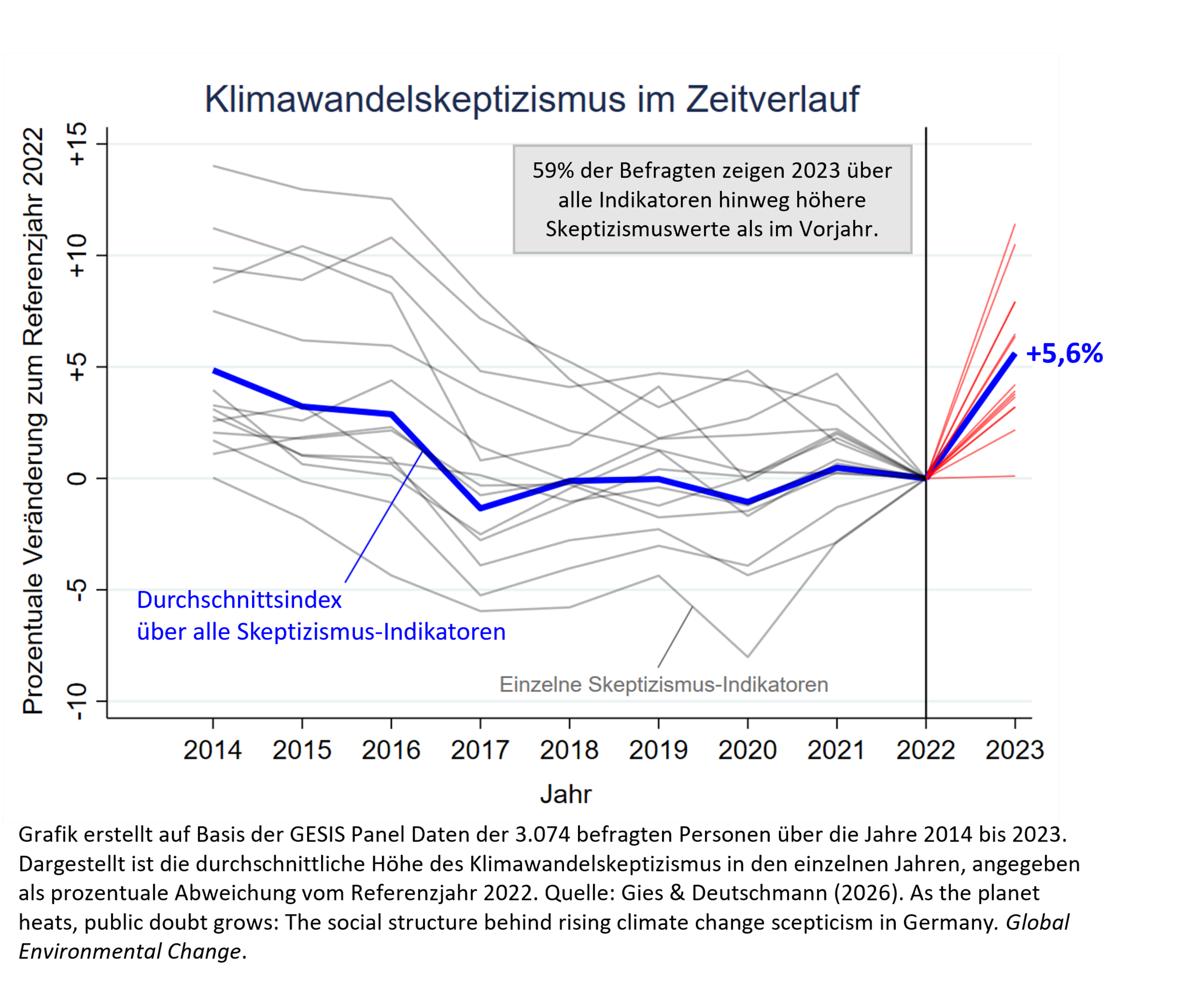
In a new study, researchers at Europa-Universität Flensburg show that climate change skepticism in Germany is no longer a fringe phenomenon. Skepticism toward climate change and related processes and policies increased significantly between 2022 and 2023 for the first time in years. The study makes it clear that the increase is particularly pronounced among people with right-wing political views, low trust in the federal government, and a hierarchical view of the world.
Examining climate change skepticism across multiple dimensions
The attitudes of 3,074 individuals were analyzed based on representative survey data for the period between 2014 and 2023. The individuals answered 14 different questions regarding their attitudes towards climate change, its consequences, and climate policy instruments. Sociologists Katharina Gies and Prof. Dr. Emanuel Deutschmann categorized these questions into five dimensions of climate change skepticism:
- Do individuals fundamentally doubt the existence of the climate crisis?
- Do individuals question whether the climate crisis is the result of human activity?
- Are the consequences of climate change not recognized as such?
- Are processes to combat climate change, such as energy transition or decarbonization, challenged?
- How are climate policy measures, such as environmental taxes, assessed?
Sharp increase between 2022 and 2023
The focus is on the sharp increase between 2022 and 2023: In 2023, 59 percent of those surveyed held overall more skeptical attitudes toward climate change than in the previous year. 93 percent of those surveyed expressed greater doubts in at least one of the 14 question areas. In particular, the number of skeptics rose sharply in the group that had previously expressed low levels of skepticism. “Our findings clearly show that skepticism is a complex and widespread phenomenon that cannot simply be ignored. Skeptical attitudes relate to various dimensions involved in dealing with the ecological crisis and are closely linked to subjective, political dimensions of attitude,” explains Katharina Gies.
Skepticism has not only increased towards specific climate policy instruments, such as an environmental tax. Doubts have also risen regarding the existence of an environmental crisis, as well as about the necessity and effectiveness of decarbonization processes.
The link between institutional distrust and climate change skepticism
In contrast to earlier studies, the researchers focus specifically on socio-structural factors associated with changes in skepticism. One thing becomes particularly clear: The sharp rise in skepticism cannot be explained simply as a result of individual economic circumstances. Instead, subjective attitudinal factors are decisive—such as right-wing political orientations, distrust of government institutions, individualistic and hierarchical orientations, and dissatisfaction with democracy.
In addition to the scientific relevance, the authors also emphasize the political implications: “Anyone who wants to broadly anchor climate protection and transformation processes in society and make them accessible must take these attitudes seriously and ensure that climate protection is socially just. If the loss of trust and the dissatisfaction with political institutions continue to grow, doubts may intensify not only regarding environmental protection measures but also regarding the seriousness of the ecological crisis itself,” says Prof. Dr. Emanuel Deutschmann.
GESIS Panel dataset
The GESIS Panel is a longitudinal study that has been conducted several times a year since 2013 by the Leibniz Institute for the Social Sciences. It is based on a random sample of individuals aged 18 and over who are registered residents in Germany, and comprises approximately 5,400 participants. The dataset is thematically very diverse and captures both key socio-structural characteristics and attitudes towards climate change.
The study As the Planet Heats, Public Doubt Grows: The Social Structure behind Rising Climate Change Skepticism in Germany has just been published in the peer-reviewed academic journal Global Environmental Change.

Katharina Gies
Wissenschaftliche*r Mitarbeiter*in
- Phone
- +49 461 805 2853
- katharina.gies-PleaseRemoveIncludingDashes-@uni-flensburg.de
- Street
- Auf dem Campus 1b
- Post code / City
- 24943 Flensburg
Prof. Dr.Emanuel Deutschmann
Juniorprofessoren
- Phone
- +49 461 805 2570
- emanuel.deutschmann-PleaseRemoveIncludingDashes-@uni-flensburg.de
- Building
- Gebäude Tallinn 1
- Room
- TAL 311