Welcome to the European Wasatia Graduate School for Peace and Conflict Resolution
The European Wasatia Graduate School for Peace and Conflict Resolution aims to analyse conceptions of and conditions for reconciliation in the Middle East. It refers to overarching discourses from different academic disciplines (Middle East and Political Sciences, Philosophy, Sociology, Law, Theology, Literature and Media Studies) and with regard to the German context (dealing with a dual past). Other international areas of conflict (Northern Ireland, South Africa, the Balkans) are considered relevant for initiating mutual learning processes among the Ph.D. students. The analysis of social, legal, political and (inter-)religious conditions for reconciliation is combined with learning practical dialogue skills (such as Holocaust education and Scriptural Reasoning). The aim is to train multipliers capable of fostering dialogue to address social challenges (particularily in the field of anti-Semitism) at both academic and civil society levels. The Wasatia Graduate School was awarded the Deutsche Dialogpreis in Berlin in 2025 and the Certificate of Honor in Jerusalem in 2026.
EUF Press Release - 1. October 2026
Strengthening International Ties - Memorandum of Understanding signed by the European Wasatia Graduate School of Peace and Conflict Resolution at Europa-Universität Flensburg (EUF) and EPOKA University
Prof. Dr. Ralf Wüstenberg, Director of the European Wasatia Graduate School of Peace and Conflict Resolution, welcomed the delegation from EPOKA University in Albania to the ceremonial signing of the joint Memorandum of Understanding. (read more)
Political Reconciliation and Interreligious Encounter: Joint Conference Held at Cambridge University
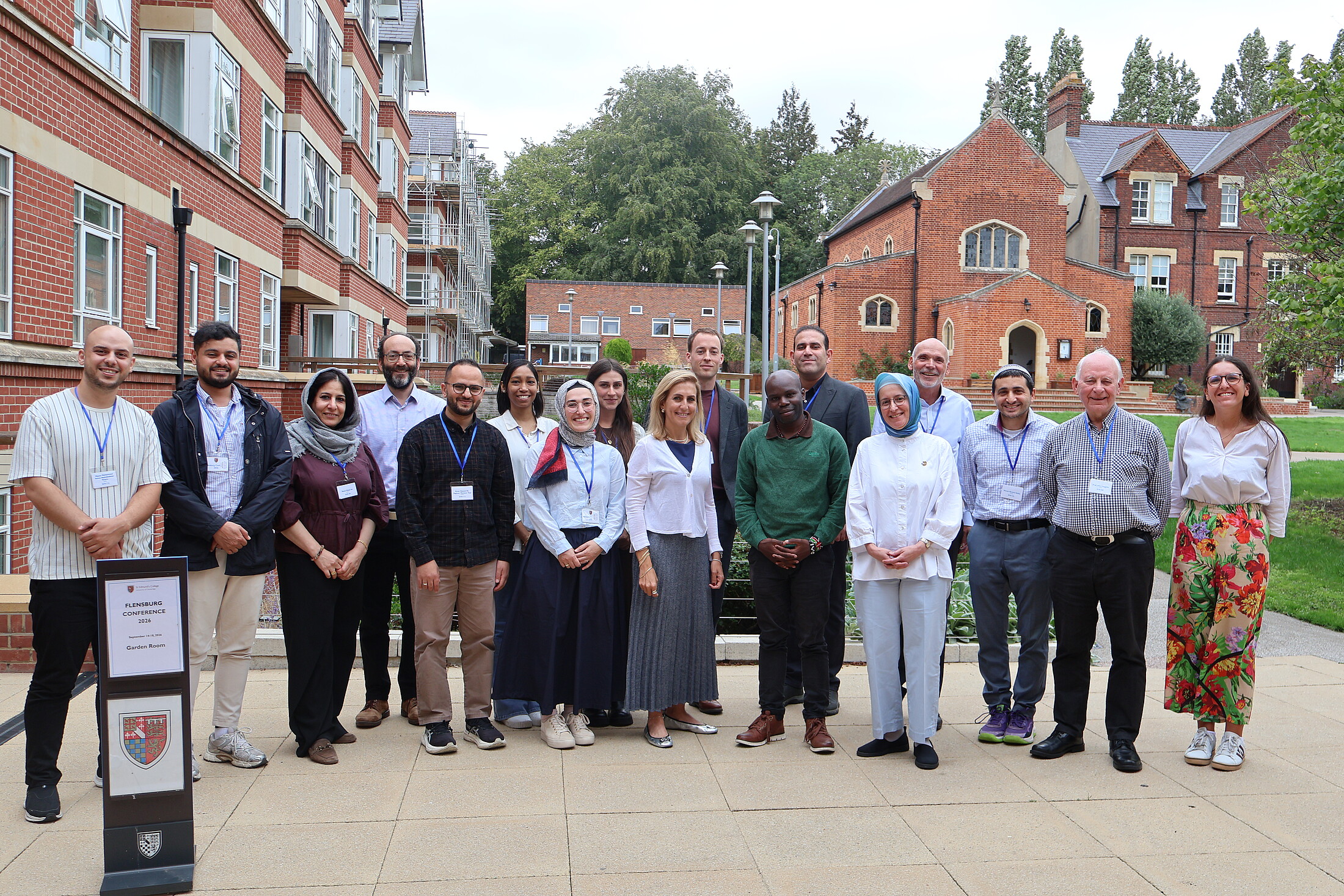
14–18 September 2026 | St Edmund’s College, University of Cambridge
European Wasatia Graduate School for Peace and Conflict Resolution and the Von Hügel Institute for Critical Catholic Inquiry (VHI) at St Edmund’s College, University of Cambridge, brought together academics and doctoral researchers for a joint conference on “Political Reconciliation and Interreligious Encounter.”
Held at St Edmund’s College, the five-day programme provided a space for interdisciplinary academic exchange on reconciliation, interreligious dialogue, human dignity, religious traditions, and the challenges of building relationships across political, religious, historical divisions, and also explored avenues to strengthen institutional collaborations between Cambridge and Flensburg, including business meetings involving Prof. Florian Bruckmann, Dean of Faculty III, EUF and Dr. Vittorio Montemaggi, Director VHI, St. Edmund’s College, and also Dr. Cynthia Lumley, Principal of Westfield House, Cambridge. (read more)
Interdisciplinary Colloquium Autumn 2027: Peace in Times of Militarisation?
Flensburg, 8.9.2026
What does it mean to speak of peace when war is becoming increasingly normalised? Across Europe and beyond, we are witnessing a profound transformation in how security, conflict and peace are understood. The language of deterrence, resilience, defence and military preparedness has moved to the centre of political and public discourse. In Germany, the declaration of a “Zeitenwende”has marked a decisive shift in security policy and raised fundamental questions about the future of European societies.
But as military preparedness becomes increasingly central to our understanding of security, an essential question remains: Where does peace fit into an increasingly militarised world? The Interdisciplinary Colloquium “Peace in Times of Militarisation?” at Europa-Universität Flensburg brings together scholars and students from philosophy, peace and conflict studies, political science and related disciplines to critically examine this question.
Rather than taking the changing security landscape for granted, the colloquium asks us to pause and reconsider some of our most fundamental assumptions: Can peace be secured through military strength? What happens to diplomacy, dialogue and reconciliation when deterrence becomes the dominant language of security? Can societies prepare for war without making war itself increasingly thinkable? And what forms of peace remain possible when conflicts appear to have no clear end?
These questions are not merely matters of foreign policy. They concern the societies we are becoming, the values we seek to protect, and the futures we imagine. The colloquium opens with a keynote lecture by Professor Pumla Gobodo-Madikizela of Stellenbosch University, one of the world’s leading scholars of reconciliation, transitional justice and traumatic memory. As a former member of South Africa’s Truth and Reconciliation Commission, she brings decades of experience in confronting the legacies of violence and exploring how societies can move from histories of conflict towards more peaceful futures. Her contribution offers a particularly powerful starting point for our conversation: What can reconciliation teach us at a time when the political imagination is once again increasingly shaped by war?The Interdisciplinary Colloquium invites the university community and the wider public to join us in creating a space for critical reflection, dialogue and intellectual exchange.
Because peace is not simply the absence of war. It is a question of how we choose to live together, and of what kind of future we are willing to imagine.