Visibilizing Normative Regional Historical Multilingualism 2.0: The North Frisian Element
The ViNoRHM Project was extended to a second 3-year funding period, which runs from 01 September 2026 to 31 August 2029.
The project builds from work initiated in ViNoRHM 1.0, which reframed narratives surrounding multilingual societies and everyday language use by offering a new approach to multilingual regional language histories that combines political and social history and is underscored by primary linguistic data. To deepen the understanding of the region’s bi-/multilingual language history, and to highlight the intricacies of navigating daily language use in a minority language context, ViNoRHM 2.0 examines North Frisian in writing ‘from below’, created by everyday writers in informal contexts, and supplements this with data from experienced, well-known, or influential NF writers who wrote NF texts in more formal contexts, e.g., for local periodicals with a ‘local or regional’ focus.
ViNoRHM 2.0 first reinterprets data collected in ViNoRHM 1.0 to contextualize NF writings in comparison to writings in neighboring languages in the 19thcentury, then traces the development and standardization processes that influence NF in contact with a majority language (and several additional smaller or regional varieties). By centering North Frisian writings by everyday writers from the 19th century – prior to codified norms or standardization attempts – and linking them with North Frisian writings and local/regional periodicals from the 20th century to the present, individual and community language practices are explored in a new way. Particular attention is paid to the role of women in this historical and minority language constellation, in an attempt to visibilize their impact on the region’s cultural and linguistic history, as women – among others – have traditionally been excluded or invisibilized in linguistic (and social and political) history.
- Principal Investigator: Dr. Samantha M. Litty
- Finanzierung: DFG
- Duration: 01.09.2026-31.08.2029
- Project page
SMiLE Revisited
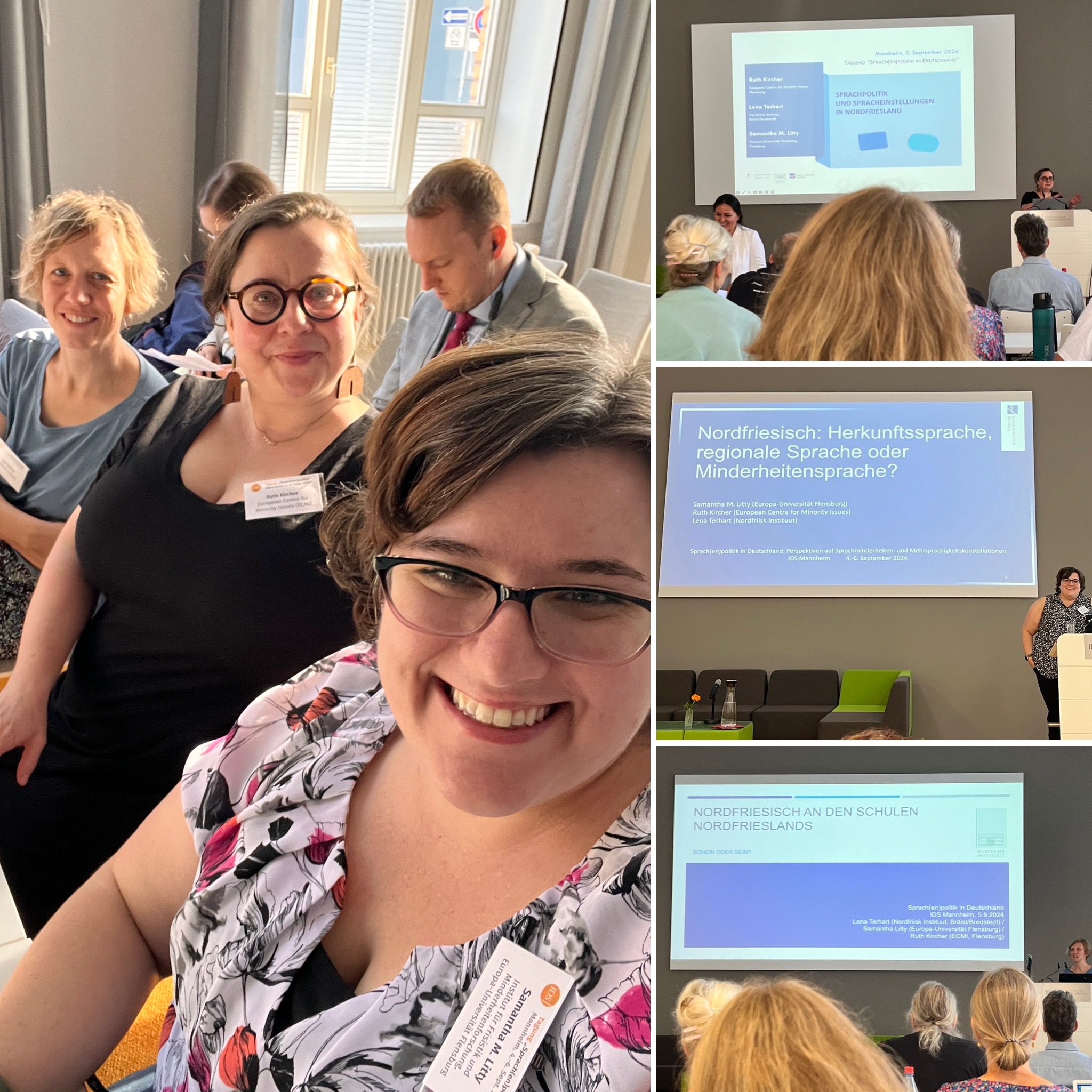
The SMiLE Revisited project provides new analyses of the North Frisian data originally collected as part of the Sustaining Minoritized Languages in Europe (SMiLE) project, examining these data (transcripts of 87 interviews) from new perspectives. The re-analyses focus on three key aspects:
- the terminology used to refer to North Frisians and their language - a comparison of language community, academics, and policy makers;
- attitudes towards North Frisian - a corpus-assisted discourse study comparing traditional, new, and non-speakers of this minority language; and
- perceptions of North Frisian in the linguistic landscape.
A report on the original SMiLE project — authored by Femmy Admiral, Lena Terhart, and Nils Langer — can be found here.
The co-investigators for the SMiLE Revisited project are Ruth Kircher (European Centre for Minority Issues), Samantha M. Litty (Europa-Universität Flensburg), and Lena Terhart (Nordfriisk Instituut).
- Litty, Samantha M., Ruth Kircher, & Lena Terhart. 2026. Minderheitensprache, heritage language oder Familiensprache? Überlegungen zur Sprachbegrifflichkeit am Beispiel des Nordfriesischen. Sprachpolitik und Sprachenpolitik. 1. IDS-Verlag Mannheim. DOI: https://ids-pub.bsz-bw.de/frontdoor/index/index/docId/13633
For more nfo on this ongoing project, see our Open Science Framework project page.
Lower Sorbian linguistic spaces
As part of the revitalization of Lower Sorbian, the question of under what conditions language use can be enabled and strengthened, and which spaces are important for the use of the language, is becoming increasingly relevant. Julija Běrinkowa’s doctoral project, "Language Spaces of Lower Sorbian" (*Sprachräume des Niedersorbischen*), addresses this issue by examining the current use of Lower Sorbian and the factors influencing it in everyday life.
Based on an understanding of language as a local and social practice, the focus is less on language as an abstract system and more on the people who use it. Central to this approach are the individual lifeworld of Lower Sorbian users and their experiences with the language. The study examines how language use plays out in various everyday situations, the social and spatial contexts in which Lower Sorbian is used, and the factors influencing the decision to use—or not use—the language. It also aims to reveal how language users themselves perceive and shape their linguistic possibilities and the linguistic spaces available to them.
The study employs a qualitative and exploratory research design. It begins with a comprehensive examination of the current situation of Lower Sorbian and its ethnolinguistic vitality, supplemented by situational descriptions and other empirical approaches. At the heart of the qualitative study are interviews with Lower Sorbian speakers and/or stakeholders involved in language policy. The perspectives of the individual interviewees are treated as cases, documented through case portraits, and subjected to comparative analysis. The research process is cyclical in nature, allowing insights gained at various stages of the study to inform subsequent empirical and theoretical analysis.
In this way, a differentiated picture should emerge of who uses Lower Sorbian, in which different linguistic areas the language is used and which factors influence language use. The aim is to relate users, linguistic areas and influencing factors to one another and thereby contribute to a better understanding of the everyday use of a highly endangered minority language. At the same time, the results should open up new perspectives on the question of how language use can be understood and strengthened in the long term in the context of the revitalization of Lower Sorbian.
The neuro-cognitive and behavioral interplay between linguistic awareness, metacognitive efficiency, and decision-making strategies

Importantly, experience with multiple languages may influence metalinguistic awareness, which is closely linked to grammaticality (the individual ability to test whether an utterance can be generated by internalized grammar) and acceptability (judgment of whether an expression is correct or wrong, which is affected not only by grammaticality, but also by socio-cultural factors). Metalinguistic awareness can influence the attitude toward speakers of other languages, immigrants and non-native speakers, speakers of minority languages, speakers of regional accents and dialects, and through that modulate tolerance to different lifestyles, values, ideas. The proposed project will contribute to an explanation of why people in different communities make different decisions even if they have the same information. We aim to reveal the social engineering "tricks" – how social attitudes and behaviors can be orchestrated in pre-planned directions via language manipulation. We will develop strategies to make individual decisions resilient to such manipulations by engaging general mechanisms of metacognition and metalinguistic awareness.
Project Lead: Prof. Nils Langer, with Dr. Leona Polyanskaya and Dr. Mikhail Ordin
Funder: VW-Stiftung (480,000 Euro)
Further Team Members: 2 x postdoctoral researchers, 1 PhD student
Keywords: Metacognition, bilingualism, multilingualism, linguistics, psychology, medical imaging
Duration: 01.03.2025 - 28.02.2028
Institutionen der EUF: Institut für Frisistik und Minderheitenforschung, Interdisziplinäres Europaforschungszentrum (ICES),
Modern North Frisian – A study on the discrepancy between language norms and language use
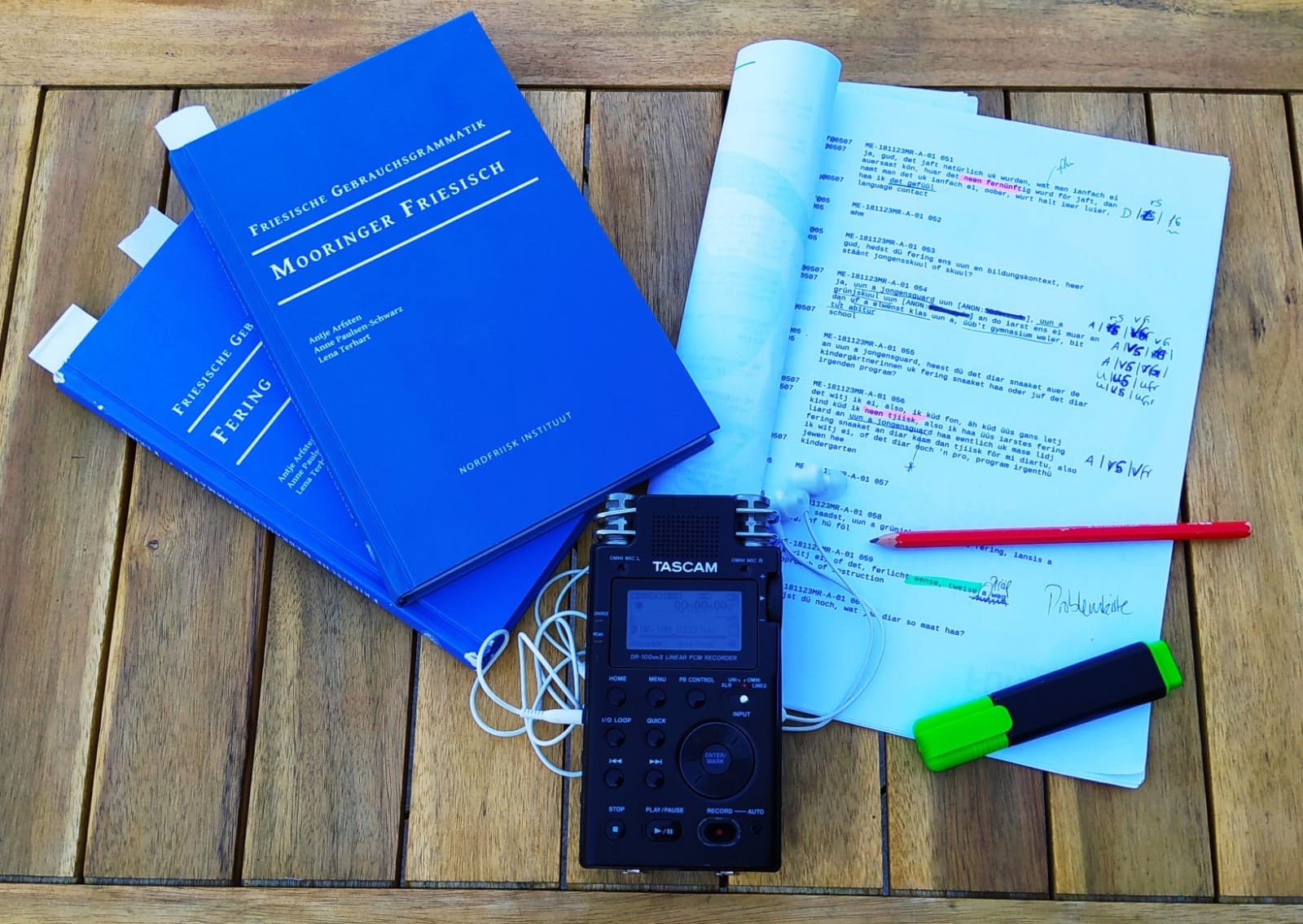
A frequently discussed topic in minority language linguistics is the impact of language contact with a majority language. This contact usually results in a change in the language system, especially in the minority language. Newer language contact phenomena, however, rarely find their way into codified language descriptions, as deviations from the norm are usually viewed negatively. For this reason, linguistic features and constructions, which are not found in the codex, give the impression that they are not common in language use, although these are sometimes already well established there.
The goal of Meike Ohlsen's dissertation is to show the discrepancy between what is considered to be the norm in codified North Frisian and that which can actually be documented in language use. This is done through the analysis of language data collected from ca. 50 interviews with North Frisian speakers conducted in 2019-2024. Additionally, it also discusses how language contact phenomena are perceived by various interest groups and which effects this can have on language use. Such a corpus also provides current language data for linguistic descriptions of North Frisian which were not previously available.
Multilingualism in the 19th century – the Ranzelberg Guestbook
The Guestbook from the legendary "Petersburg" country inn, once found on the Ochsenweg between Husum and Tønder, in today's Langenberg Woods, has been housed in the archive of the Nordfriisk Instituuts (NFI) in Bredstedt since 2018. In a collaborative project with the EUF, generously funded by the Stiftung für die Friesische Volksgruppe im Lande Schleswig-Holstein (Friesenstiftung/Friisk Stifting), the guestbook is being transcribed, with the hope of producing an academic publication, giving the public access to the stories and secrets the guestbook holds, but which also situates the guestbook in its historical context. Project leader is Dr. Samantha M. Litty.
For Christmas 1834, several seminarians attending the Tønder teaching seminary gifted the guestbook to the innkeeper, Peter Matthiesen (thus the name "Petersburg"). Generations of seminarians, who referred to themselves as "Burschen" - a term restricted to members of German fraternities, which the seminarians were not - immortalized themselves in the pages of the guestbook over the following five decades. Through this extraordinary source we are able to gain insights into the "Burschen"-existence of the time. Whether on their way to exams or home for the holidays, whether in a good mood or not, the seminarians regularly embellished their entries with songs, rhyming couplets, famous quotes, or toasts. Other travelers through the region, such as sailors traveling from the North Frisian islands to the Baltic, or cattle herders and tradesmen, added to the guestbook as well. These entries were sometimes "edited", commented on, ridiculed, or even entirely removed from the guestbook by the seminarians, who considered the guestbook to be their property. By 1888, over 400 pages of the guestbook were filled. Alongside entries in German, there are a good number of entries in Danish, and a handful in Frisian. Additionally, entries were often decorated with bits in Latin, French, and Low German.
Student assistants: Anna Sophie Blaue (2021-2022), Ilka Thomsen (2021-2023), Jan Momme Penning (2021-2024), Andre Hermann (2023-2025)